
Is irritability a symptom of depression? Yes, it can be, and for some people it’s the clearest symptom of all. Depression doesn’t always show up as tears or days spent in bed. In many adults, it looks like a short temper, constant impatience, or a tense, on-edge feeling that won’t go away.
When that irritability lasts for weeks and comes with poor sleep, low energy, or a loss of interest in things that used to matter, it may point to an underlying depressive disorder rather than a rough patch. The connection between irritability and depression is well documented in clinical research, yet it gets far less attention than sadness does.
The Short Fuse That Doesn’t Feel Like Depression
Most people know what their normal level of patience looks like, which is why a sudden change can feel so confusing.
Small Annoyances, Big Reactions
A slow line at the pharmacy feels unbearable. A partner’s simple question sounds like criticism. The sound of someone chewing becomes a reason to leave the room.
Afterward comes a wave of guilt and a nagging question: why does everything feel so irritating lately?
Stress Or Something Deeper?
It’s easy to blame a demanding job or a few bad nights of sleep. Sometimes that really is the whole story.
But when the short fuse sticks around for weeks, it’s worth asking what might be driving it.
Why Depression Doesn’t Always Look Sad
The popular image of depression is narrow, and it leaves a lot of people out.
Depression Affects More Than Sadness
Most people imagine someone quiet, withdrawn, and tearful. That version is real, but it’s only one version.
Depression changes how the brain handles emotions in general. For some people, the feeling that dominates is frustration or anger, not sadness.
4 Reasons This Form Of Depression Goes Unnoticed
- Anger looks like a personality issue. Friends and family react to the behavior instead of asking what’s behind it.
- Some people learned to show distress as irritation. This is especially common in men, who may have been taught that sadness isn’t acceptable to show.
- The person may not feel “depressed” at all. They just feel worn down and fed up with everyone.
- Stress gets the blame. Work pressure or relationship conflict seems like an obvious explanation, so the mood disorder underneath goes unnoticed.

That’s exactly why the question “Is irritability a sign of depression?” deserves a real answer. Missing this pattern can delay treatment for months.
Is Irritability A Sign Of Depression?
In many cases, yes, especially when the irritability is persistent and shows up alongside other mood changes.
How Depression Can Show Up As Anger Instead Of Sadness
Diagnostic criteria for major depressive disorder already recognize that in children and teens, an irritable mood can take the place of a sad one.
Adults aren’t formally assessed this way. Still, clinicians see the same pattern in adults all the time.
What Recent Research Shows
A study published in January 2025 in The Primary Care Companion for CNS Disorders looked at 1,317 older adults. About 40% reported irritability. Those who met criteria for depression reported significantly more irritability than those who didn’t. The authors suggested irritability could be a useful marker for spotting depression in older patients.
So, is irritability a sign of depression every single time? No. But it’s a signal that deserves attention instead of a shrug.
What Does Irritable Depression Feel Like?
Irritable depression often feels less like sadness and more like an emotional sunburn, where almost anything touches a sore spot.
Common Experiences People Describe
- A constant low-level tension, as if bracing for the next annoyance
- Snapping at family or coworkers over things that never used to matter
- Feeling crowded by noise, questions, or simple requests
- Harsh or critical thoughts that seem to come out of nowhere
- A flat, empty feeling sitting just under the anger
- Exhaustion after an outburst, usually followed by regret
Why Does Depression Make You So Irritable?
So, can depression make you irritable on its own? It can, through several changes that tend to feed one another.
Changes In Emotional Regulation And Brain Function
Depression affects the brain networks that help regulate mood and put the brakes on strong reactions.
When the areas responsible for perspective and impulse control work less efficiently, and threat-sensitive areas become more reactive, a minor hassle can register as a major problem. For a deeper look, see this guide on how depression affects the brain and emotional health.
A Two-Way Connection Found In 2025 Research
A 2025 study in Biological Psychiatry: Global Open Science combined Swedish twin data with genetic analysis. It found a two-way link between irritability and depression.
In plain terms:
- Irritability appeared to raise the risk of developing depression
- Depression, in turn, appeared to increase irritability
- Irritability may be an early, modifiable risk factor, so addressing it sooner makes sense
Chronic Stress And Reduced Emotional Tolerance
Think of emotional tolerance as a phone battery. Depression drains it, and ongoing stress keeps it from recharging.
With so little in reserve, a work email, traffic, or a child’s meltdown feels like too much. Irritation is often the first warning light.
Poor Sleep, Fatigue, And Mental Exhaustion
Can depression make you irritable just by wrecking your sleep? Sleep plays a big part. Depression often brings:
- Trouble falling or staying asleep
- Waking far too early
- Long hours in bed that never feel restful
- Daytime fatigue and brain fog
Even a few short nights can shrink anyone’s patience, and simple tasks start to feel frustrating.
When Anger Masks Sadness: 7 Signs Of Depression-Related Irritability
None of these signs confirms a diagnosis alone, but several of them together suggest a pattern worth talking through with a professional.
1. Small Problems Trigger Disproportionate Reactions
A dropped fork or a late bus sets off a reaction far bigger than the moment calls for. Later, it’s hard to explain why it hit so hard.
2. You Feel Angry But Cannot Explain Why
The anger has no clear target. It’s simply there, in the morning, at work, and at home, without an obvious cause.
3. You Withdraw To Avoid Snapping At Others
Some people pull away from friends and family not because they don’t care, but because they’re worried about saying something hurtful. Distance feels like protection, yet it often deepens the low mood.
4. You Feel Guilty After Angry Outbursts
Shame after an outburst is common with depression and irritability. That guilt then feeds self-criticism, which makes the next blowup more likely.
5. Your Patience And Motivation Have Declined
Tasks that once felt routine now feel like obstacles. Low motivation and thin patience usually travel together.
6. Your Irritability Comes With Sleep Or Appetite Changes
Sleeping or eating noticeably more or less than usual, alongside a short temper, points toward a mood disorder rather than a passing mood.
7. You Feel Emotionally Numb Rather Than Sad
Many people with irritable depression don’t feel sad at all. They feel flat, disconnected, or unable to enjoy anything, a symptom called anhedonia. Irritation becomes one of the few emotions that still breaks through.
Irritability Vs Ordinary Anger: How Can You Tell The Difference?
Everyone gets cranky sometimes, so the real difference lies in the pattern, not in one bad afternoon.
Side-By-Side Comparison
Feature | Everyday Irritability | Irritability Associated With Depression |
Triggers | Often linked to a specific situation | May occur frequently or with minor triggers |
Duration | Usually improves as the situation resolves | May persist over days or weeks |
Other symptoms | May occur without broader mood changes | Can accompany fatigue, hopelessness, or anhedonia |
Daily functioning | Usually causes limited disruption | May interfere with work, relationships, or daily activities |
Emotional recovery | Often settles after rest or resolution | May remain difficult even when circumstances improve |
Quick Self-Check Questions
- Has your mood changed compared with a few months ago?
- Have people close to you started commenting on your temper?
- Do you still enjoy the things you used to love?
- Does a good night’s sleep or a quiet weekend actually help?
When It’s Time For An Evaluation
A practical rule of thumb: if irritability has lasted two weeks or more and comes with several of the signs above, it’s reasonable to book an evaluation.
Other Conditions That Can Cause Persistent Irritability
Not every short temper traces back to depression, which is why a professional assessment matters.
Common Look-Alike Causes
- Anxiety disorders, where constant worry keeps the nervous system on high alert
- PTSD and other trauma-related stress
- Physical health issues, such as thyroid problems, hormonal shifts, or chronic pain
- Substance use or withdrawal
- Side effects from certain medications
Why Ruling Out Bipolar Disorder Matters
In bipolar disorder, especially during mixed episodes, irritability may come with racing thoughts, less need for sleep, and impulsive choices.
Treatment plans differ, so a careful clinician will ask about past periods of unusually high energy first. LifeQuality TMS also offers specialized bipolar depression treatment.
Treatment Options For Depression-Related Irritability
Treating depression and irritability usually means treating the depression itself, and when mood improves, the short fuse often eases too.

Psychotherapy For Depression And Emotional Regulation
Therapy helps people notice what sets off their reactions and what’s going on underneath them. It can help a person:
- Spot triggers and early warning signs before an outburst
- Understand stress responses, including how the body reacts before the mind catches up
- Communicate more clearly with partners, family, and coworkers
- Work through loss, guilt, hopelessness, or unresolved distress
Therapy Styles That Can Be Adapted
Approaches like cognitive behavioral therapy (CBT) and interpersonal therapy can be shaped around individual needs and preferences. There’s no single right style for everyone.
Antidepressant Medication And Mood Symptoms
Antidepressants can reduce depressive symptoms, and for many people that includes irritability. Responses vary a lot, so choosing the right medication and dose requires a professional assessment.
When Medication Itself Adds To Irritability
Agitation or increased irritability can sometimes appear as a side effect, especially early on or after a dose change.
If that happens, it should be discussed with the prescribing clinician rather than handled by stopping the medication suddenly.
Deep TMS For Depression When Other Treatments Have Not Helped
For people with major depressive disorder who haven’t improved enough with medication or therapy, transcranial magnetic stimulation (TMS) offers another option.
How TMS Works
TMS is a noninvasive treatment that uses magnetic pulses to influence brain networks involved in mood regulation. Because it targets the depression itself, successful treatment may also ease low mood, emotional distress, and irritability.
What 2025 Research Says About TMS And Irritability
A 2025 randomized trial in The Journal of Clinical Psychiatry followed adolescents with major depressive disorder who received TMS. Key findings:
- Irritability improved significantly over the six-week course
- That improvement happened alongside lower overall depression scores
- Early drops in irritability were tied to a better overall response
The study was exploratory and focused on teens, but it supports a simple idea: when depression lifts, irritability often lifts with it.
Who TMS Is And Isn’t For
TMS is not an established treatment for ordinary anger or irritability on its own. It’s used when there’s an appropriate clinical diagnosis, such as major depressive disorder.
Deep TMS Treatment At LifeQuality TMS
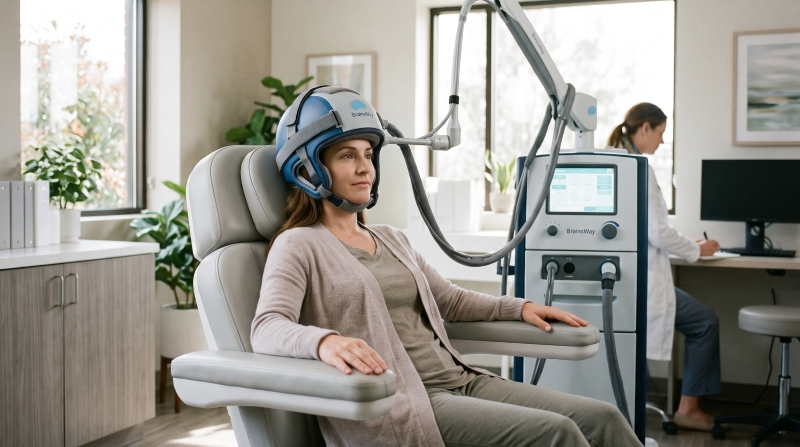
LifeQuality TMS, located in Downtown Brooklyn near Brooklyn Heights, uses the BrainsWay Deep TMS system.
Why BrainsWay Deep TMS
The BrainsWay system is designed to reach broader and deeper brain areas than traditional TMS coils.
What The Process Looks Like
- Professional evaluation. A licensed psychiatrist reviews symptoms, history, and past treatments to decide whether Deep TMS is a good fit.
- Insurance support. The team handles prior authorization paperwork with most insurance plans.
- Outpatient sessions. Patients stay awake and seated comfortably, with no anesthesia.
- Back to the day. Most people return to work, driving, and normal routines right after.
Care That Fits Your Existing Treatment
The clinic works alongside patients’ current therapists and prescribers, so TMS becomes part of the bigger plan. Here’s more on the factors that shape a personalized TMS plan.
Recognizing The Depression Behind Irritability
Depression doesn’t always arrive looking sad, and sometimes the clearest clues are impatience, frustration, or quietly pulling away from people.
When To Take A Short Temper Seriously
Occasional irritability is a normal part of being human. It deserves a closer look when it comes with:
- Low energy or constant fatigue
- Poor sleep or appetite changes
- A loss of joy in things that used to matter
- Strain at work or in close relationships
Taking The First Step
If you’ve been wondering, “Is irritability a symptom of depression in my case?”, that question alone is a good reason to talk with a professional. Understanding the link between irritability and depression is often the first step toward feeling like yourself again.
Get An Evaluation At LifeQuality TMS
For people whose depression hasn’t responded to medication or therapy, Deep TMS may be worth exploring. Contact LifeQuality TMS to schedule an evaluation and find out whether BrainsWay Deep TMS is a good fit.
Frequently Asked Questions
Why Does Depression Make People So Angry?
Depression drains emotional energy, disrupts sleep, and weakens the brain’s ability to calm strong reactions. With less patience in reserve, small frustrations feel bigger, and anger often becomes the easiest emotion to reach.
Is Irritability A Symptom Of Depression Or Just Stress?
It can be either. Stress-related irritability usually fades once the stressful situation passes. Irritability that sticks around for weeks, especially with fatigue, sleep changes, or loss of interest, is more likely tied to depression.
Can Depression Make You Irritable Even Without Feeling Sad?
Yes. Some people with depression feel numb, flat, or empty rather than sad, and irritability becomes the most visible symptom. That’s one reason this form of depression is so often overlooked.
Can Antidepressants Make Irritability Worse?
Sometimes. Agitation or increased irritability can appear as a side effect, often early in treatment or after a dose change. Anyone who notices this should talk with their prescriber instead of stopping the medication on their own.
How Can Someone Stop Snapping At Loved Ones During Depression?
Small steps help in the moment:
- Step away for a few minutes when tension starts building
- Name the feeling out loud, for example, “I’m worn out, not upset with you”
- Protect sleep as much as possible
- Apologize once, then move on rather than spiraling into guilt
Lasting change, though, usually comes from treating the depression underneath.