
How does depression affect the brain? It changes how key brain regions work and how they talk to each other. The area that plans and calms emotions tends to quiet down, the threat detector gets louder, and the reward system stops responding the way it used to.
That’s why depression can drain motivation, cloud thinking, and make feelings heavy or oddly flat. The good news is that many of these changes appear to be reversible, and treatments such as Deep TMS therapy work directly on the circuits involved.
When Everyday Life Starts to Feel Heavy
A favorite song comes on, and nothing happens. No lift, no urge to turn the volume up. Deciding what to make for dinner takes ten minutes and still feels like too much. Thoughts move slowly, as if they’re wading through wet sand.
Moments like these often show up before anyone uses the word “depression.” Early signs include:
- Hobbies that once felt exciting now feel like chores
- Simple choices, like what to wear, leave a person drained
- Conversations are hard to follow or remember later
- Sleep doesn’t bring real rest

Depression Is More Than a Bad Mood
These moments are easy to blame on laziness, but that’s rarely the full story. Ordinary sadness fades with time. Depression lingers and reaches into the systems that handle memory, motivation, emotional balance, and decision-making.
Brain imaging has made one point fairly clear: depression is less about a single “broken” spot and more about communication. Below is a plain-language look at how depression affects the brain, why it shapes emotions the way it does, and which evidence-based treatments target these circuits.
How Does Depression Affect the Brain?
Depression mainly changes how brain networks share information, and in some people it’s also linked to physical differences in brain tissue.
Depression Changes How Brain Networks Communicate
The brain works less like separate offices and more like a road system, where what matters most is how smoothly traffic moves between regions. Four networks come up again and again in depression research:
- Default mode network. Active during self-reflection; in depression, it often runs too hot and feeds rumination.
- Salience network. Decides what deserves attention, flagging threats and rewards.
- Central executive network. Handles focus and planning, and tends to be underpowered in depression.
- Reward network. Drives motivation; when it goes quiet, so does the desire to do much.
What Functional Connectivity Means
Scientists measure how well these regions stay in step with functional connectivity, which simply means how often two areas become active at the same time on a scan. Among the most studied effects of depression on the brain is a shift in this timing. The inward-looking network grips too tightly, which can feel like being trapped in one’s own head.
Does Depression Change Brain Structure or Only Brain Activity?
Both can happen, though they’re quite different:
- Functional changes involve how the brain is working, such as activity and signaling. They can shift within weeks of effective treatment.
- Structural changes involve the physical tissue, like the size of a region or the thickness of the cortex.
Structural differences tend to be modest, and the hippocampus shows them most consistently. A 2025 analysis of more than 50,000 people found that a higher genetic risk for depression went hand in hand with slightly smaller volumes in areas like the hippocampus and thalamus. Still, these are group averages. They describe depression and the brain effects seen in research, not something a doctor can read off one person’s scan.
5 Brain Regions and Systems Affected by Depression
No single spot “causes” depression; instead, several regions shift together, and each explains a different piece of the experience.
1. Prefrontal Cortex: Decision-Making and Emotional Control
The prefrontal cortex, just behind the forehead, plans, weighs options, and brakes emotional reactions. In many people with depression, the left side of this area shows lower activity than usual. That’s why picking a shirt or replying to a text can feel oddly draining. This same area is the main target of TMS therapy.
2. Amygdala: Fear, Stress, and Negative Emotions
The amygdala scans for danger around the clock. During depression, it reacts more strongly to negative signals and less to positive ones. Without firm prefrontal control, a small setback can turn into hours of worry.
3. Hippocampus: Learning and Memory
The hippocampus stores and retrieves memories, and it’s packed with receptors for cortisol, the main stress hormone. In a 2026 study of 2,009 older adults, people with depression tended to have a smaller section of the hippocampus that helps tell similar experiences apart. That fits the brain fog many people describe.
4. Reward Circuits: Motivation and the Ability to Feel Pleasure
The reward system leans heavily on dopamine and handles two jobs: wanting something and enjoying it. Depression can dull both, a state doctors call anhedonia. Looking at depression and how it affects the brain makes this symptom far less mysterious.
5. Anterior Cingulate Cortex: Emotional Processing and Attention
The anterior cingulate cortex (ACC) links thinking and feeling and steers attention. In depression, part of it often becomes overactive, and attention tends to snag on negative thoughts and stay stuck.
Brain Regions and Symptoms at a Glance
Here’s a quick look at how depression affects the brain, region by region:
Brain region or system | Normal role | How depression may show up |
Prefrontal cortex | Planning, decisions, emotional control | Indecision, mental fatigue |
Amygdala | Detecting threats and stress | Heightened worry |
Hippocampus | Forming and recalling memories | Forgetfulness, brain fog |
Reward circuits | Motivation and pleasure | Loss of interest, low drive |
Anterior cingulate cortex | Emotion and attention control | Getting stuck on dark thoughts |
How Depression Affects Emotional Health and Everyday Feelings
These brain changes show up as real feelings, sometimes heavy and sometimes strangely absent.
Persistent Sadness, Hopelessness, and Negative Thinking
Depressive sadness settles in for weeks. With a jumpy amygdala and a quieter prefrontal cortex, bad news gets extra weight, leading to patterns like:
- Assuming the worst outcome is the most likely one
- Remembering mistakes far more clearly than wins
- Hearing neutral comments as criticism
- Feeling sure that nothing will ever improve
These thoughts feel like facts, but they’re better seen as symptoms shaped by real effects of depression on the brain.
Emotional Numbness and Difficulty Feeling Pleasure
Not everyone with depression feels sad. Many describe emptiness instead, as weaker dopamine signaling makes it hard to feel any payoff. This numbness often looks like:
- Good news that lands flat
- Time with loved ones that feels like going through the motions
- Little reaction to music, food, or favorite shows
It’s one of the forms of depression, and the brain effects that loved ones miss most often, since it doesn’t look like distress from the outside.
Irritability, Frustration, and Emotional Sensitivity
Depression can also show up as a short fuse, especially in teens (see depression treatment for teenagers). Weaker prefrontal control leaves less space between a feeling and a reaction, and that’s not a character flaw.
How TMS Therapy Targets Brain Circuits Involved in Depression
If depression involves circuits falling out of sync, treating those circuits directly makes sense, and that’s what TMS does.
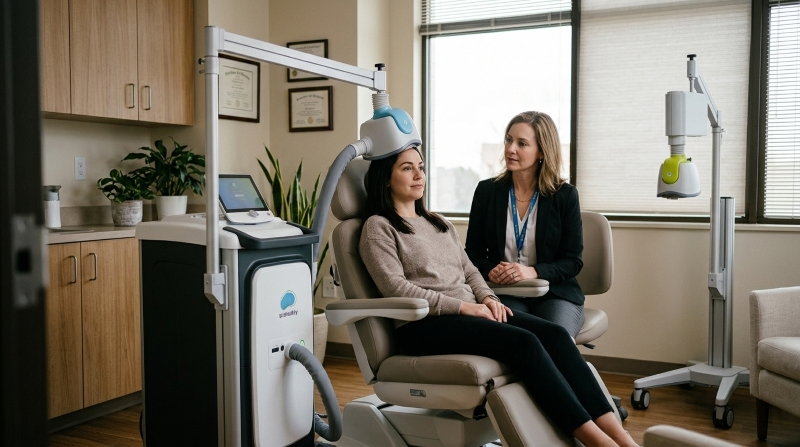
How Transcranial Magnetic Stimulation Works
Transcranial magnetic stimulation (TMS) uses a coil placed near the scalp to deliver repeated magnetic pulses. These pulses induce small electrical currents that make nerve cells in the targeted area fire. Over many sessions, this appears to boost activity in underactive regions, most often the left prefrontal cortex. In other words, TMS aims at the same circuits behind many effects of depression on the brain.
What a Typical TMS Session Looks Like
A session usually involves:
- Sitting in a comfortable chair while fully awake
- No anesthesia, needles, or medication
- A tapping sensation on the scalp during the pulses
- Returning to work or daily plans right afterward
Mild headache or scalp discomfort are the most common side effects. More answers are collected on the LifeQuality TMS FAQ page.
What Is Deep TMS, and How Is It Different from Traditional TMS?
Deep transcranial magnetic stimulation (dTMS) was developed by BrainsWay. Traditional TMS often uses a figure-eight coil that produces a focused field near the brain’s surface. BrainsWay’s patented H-coil is built to reach broader and deeper regions, which matters because depression involves whole networks.
The key differences between rTMS and dTMS are worth a read. Schedules are getting shorter, too: in September 2025, the FDA cleared an accelerated Deep TMS protocol that fits the first phase into six treatment days instead of about four weeks.
Can TMS Improve Mood, Motivation, and Cognitive Symptoms?
TMS is FDA-cleared for major depressive disorder in appropriate patients, typically adults who haven’t found enough relief from medication. Its main goal is to reduce symptoms. When it works, people may notice:
- A lighter, steadier mood
- Renewed interest in hobbies and friends
- More energy and less of that slowed-down feeling
- Better day-to-day functioning at work and at home
Understanding the Brain Is Part of Understanding Depression
Depression reaches well beyond mood. Seeing how depression affects the brain explains symptoms that can otherwise feel confusing or shameful:
- Lingering sadness and hopelessness
- Emotional numbness
- Brain fog and forgetfulness
- A slow fade of interest in things that used to matter

These findings don’t mean permanent damage, and many changes shift with recovery. For depression that hasn’t eased with medication or talk therapy, LifeQuality TMS offers Deep TMS with BrainsWay technology.
Frequently Asked Questions
Does Depression Cause Permanent Brain Damage?
There’s no evidence that depression inevitably causes permanent damage. Hippocampal findings are group averages, and the brain keeps its ability to rewire at every age.
Can the Brain Heal After Depression?
In many cases, yes. Research on depression and how it affects the brain shows that activity and connectivity often move back toward typical levels as symptoms improve.
Why Does Depression Make It So Hard to Think Clearly?
Lower prefrontal activity, hippocampal changes, poor sleep, and constant rumination all drain mental energy. Brain fog is a recognized symptom, not a sign of low intelligence.
Can a Brain Scan Show If Someone Has Depression?
Not yet. Scans reveal differences between groups in research, but diagnosis still depends on a clinical evaluation.
Does Depression Change a Person’s Personality?
It can feel that way. Still, irritability and flat emotions are usually symptoms of depression and the brain effects that come with it, not someone’s true character, and they often fade with treatment.