The short answer: often, yes, at least to a real degree. Many of the differences seen in people with depression, especially in brain activity and the way regions communicate, can shift toward healthier patterns as symptoms improve. The adult brain stays adaptable, and effective treatment appears to work with that flexibility. Still, “reversed” doesn’t mean every trace disappears.
So it’s better to think of it not as a permanent scar. It’s a system that can be retrained. Depression shows up as altered activity, connections that are too weak or too strong, and, in some studies, small average differences in the size of certain regions.
When Depression Feels Like It Has Rewired Everything
People who have lived with depression for years often share the same worry. Months stretch into seasons, and a quiet fear sets in: what if the brain has simply changed for good?
It’s a reasonable question. Headlines about “shrinking” brain regions don’t help, and neither does the dull, foggy feeling that long-term low mood brings. The concern usually comes down to a few specific fears:
- Years of depression have caused damage that can’t be undone
- Feeling like a “normal” self again is no longer biologically possible
- Treatment can only cover up symptoms without changing anything underneath
Each of these deserves a straight answer. The research is more hopeful than most people expect.
What Scientists Mean By A “Different” Brain
Researchers haven’t found a single “depression spot.” Brain scans reveal patterns instead. The depression brain tends to show shifts in how emotional, reward, and thinking networks talk to each other, along with stress-system changes and, in some groups, slight differences in volume.
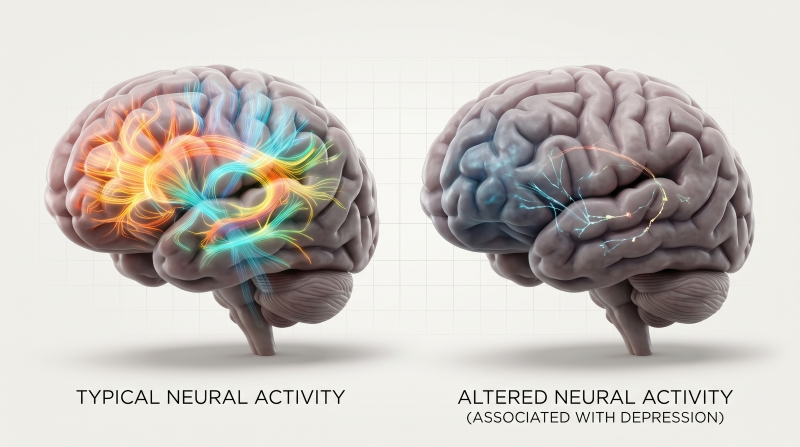
Two details matter here. When researchers compare a brain with depression vs. a normal brain, they’re working with averages across groups, so that no single scan can confirm or rule out depression in one person. And much of what they measure reflects function, which happens to be the part of the brain most open to change. For the basics, LifeQuality TMS explains how depression affects the brain and emotional health.
Depressed Brain Vs Normal: What Differences Can Be Seen?
Studies point to differences in three main areas: activity, connectivity, and, less consistently, structure.
Differences In Brain Activity And Communication
The clearest gap in normal vs depressed brain comparisons involves communication. Regions that should work together smoothly often fall out of sync. Common patterns include:
- Lower activity in the dorsolateral prefrontal cortex (DLPFC), an area tied to focus, planning, and emotional control
- Stronger reactivity in the amygdala, the brain’s threat detector, especially toward negative information
- An overactive default mode network, which is linked to rumination and self-critical thought loops
- Weaker reward signals, which help explain why favorite activities start to feel flat
Put simply, the brakes on negative emotion work less well, and the alarm system stays louder than it should.
Changes In Brain Structure And Volume
Structure is where the findings get mixed. Some studies report slightly smaller average volumes in the hippocampus, parts of the prefrontal cortex, and the anterior cingulate, mostly in people with long-lasting or recurring depression. Others find little difference, particularly during a first episode.
The link between the brain and depression runs both ways here. Long-term stress hormones may wear on memory-related regions, and those same regions help keep stress in check. It’s a loop, and that’s also why breaking it can help on several fronts at once.
Brain With Depression Vs Normal Brain: A Quick Comparison
The table below sums up the main areas where research has found differences.
Brain Feature | Without Depression | With Depression |
Emotional regulation | Typical regulation across emotional networks | Altered regulation in some individuals |
Stress response | Adaptive stress-system activity | May involve prolonged or dysregulated stress responses |
Reward processing | Typical responses to rewarding experiences | Reduced reward responsiveness may occur |
Brain connectivity | Typical communication between networks | Altered connectivity in some networks |
Brain structure | Normal individual variation | Average differences in certain regions reported in research |
Keep in mind that a brain with depression varies from one person to the next. Not everyone shows every pattern on this list.
Can Depression-Related Brain Changes Actually Be Reversed?
Evidence suggests many of them can move back toward typical patterns, though scientists use the word “reversal” more carefully than most people do in everyday speech.
What Reversibility Means In Brain Research
In research terms, reversal usually means a measure in treated patients moves closer to what’s seen in people without depression. In other words, the normal vs. depressed brain distance shrinks. That might look like:
- Connectivity between two regions returning to a typical range
- Activity in an underactive area rising after treatment
- Volume in a specific region increasing over several months
- Stress-hormone rhythms becoming steadier
Partial improvement is common. A perfect match with healthy controls is less common, and some differences can outlast the symptoms. Mood recovery and brain recovery don’t always run on the same clock.
How Neuroplasticity Supports Brain Recovery
Neuroplasticity is the brain’s ability to build new connections, strengthen useful pathways, and trim unused ones. It doesn’t switch off in adulthood. Depression seems to dampen it, partly because chronic stress lowers growth-supporting proteins such as BDNF, but treatment can help turn it back up. That’s why the relationship between the brain and depression isn’t fixed.
A 2025 study in Translational Psychiatry shows this well. Researchers scanned 30 outpatients with major depression before and after 20 sessions of cognitive behavioral therapy and found gray matter increases in parts of both amygdalae and the right hippocampus, alongside a decrease in the right posterior hippocampusю. The mixed result is worth noting. The brain clearly responded, just not in a perfectly tidy way.
Which Brain Changes May Improve As Depression Is Treated?
Several regions show encouraging shifts as symptoms ease, especially those tied to emotion, stress, and memory.
Emotional Regulation And Prefrontal Cortex Activity
The prefrontal cortex works like a manager for emotions, and in depression it often underperforms. As treatment takes hold, activity in this area and its links to deeper emotional centers tend to strengthen.
A 2025 study in Molecular Psychiatry tested brief computer-assisted CBT against a waitlist group. Along with symptom improvement, participants showed changes in cortical–subcortical connectivity, which the authors said fits the broader finding that successful depression treatment often comes with shifts in prefrontal–subcortical connectionsю
Stress Responses And Amygdala Activity
An overactive amygdala keeps the body braced for trouble. When depression lifts, people often notice they react less sharply to everyday setbacks. Brain imaging tends to back that up, with:
- Calmer amygdala responses to negative faces or images
- Stronger top-down control from the prefrontal cortex
- More balanced stress-hormone patterns over time
Memory And Hippocampal Changes
The hippocampus handles memory and helps switch off the stress response. In a brain with depression, this region can be especially sensitive to ongoing stress. The good news is that it’s also one of the few places where new neurons form in adults, which makes it a natural candidate for recovery.
Trouble with focus and recall is common in depression. LifeQuality TMS covers this in more detail in its article on depression-related brain fog and memory problems. Memory usually improves as mood does, though it may lag by a few weeks or more.
How Long Does It Take For The Brain To Recover From Depression?
There’s no fixed timeline. Changes tend to show up in stages rather than all at once:
- Days to weeks: Activity and connectivity can start shifting early in treatment.
- Several weeks: Mood, sleep, and energy usually show noticeable gains. With TMS, many patients notice improvements within 2 to 4 weeks.
- Months: Structural changes, such as shifts in volume, appear more gradually and depend on staying well.
- Longer term: Ongoing care helps protect progress, since a relapse can set things back.
How quickly depression-related brain changes ease depends on a few factors: how long the depression lasted, the number of past episodes, age, sleep, physical health, and how consistently treatment is followed. A brain with depression that went untreated for years may need more time. That doesn’t mean it can’t recover.
Can TMS Help Restore Healthier Brain Function In Depression?
TMS is one of the most direct ways to reach the circuits involved in depression, and it’s the focus of LifeQuality TMS in Brooklyn, New York.
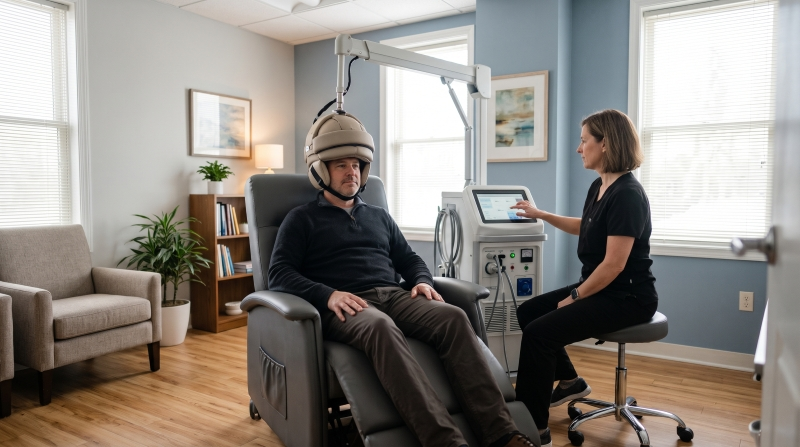
The clinic uses a BrainsWay Deep TMS device, which goes deeper and covers more area than traditional TMS. Sessions last about 20 minutes, and patients can return to normal activities, including work and driving, right afterward. This approach is especially relevant for people with major depressive disorder who haven’t found enough relief from medication or therapy alone.
How TMS Influences Brain Circuits Involved In Depression
Transcranial magnetic stimulation uses magnetic pulses to change activity in targeted brain areas. Here’s how that plays out:
- Targeting the DLPFC: Pulses aimed at the left dorsolateral prefrontal cortex boost activity in an area that’s often underactive in depression.
- Reaching connected networks: The DLPFC links to the cingulate cortex, amygdala, and reward circuits, so stimulating it can influence deeper mood networks indirectly.
- Building change through repetition: Daily sessions over several weeks appear to reinforce new patterns, much like practice strengthens a skill.
- Treating symptoms, not erasing history: TMS reduces depressive symptoms. It doesn’t guarantee that every depression-related brain difference will disappear.
A randomized trial published in 2025 in the Asian Journal of Psychiatry looked at this directly. Both the real and sham rTMS groups improved, but the active group improved more and showed increased gray matter volume in regions tied to the frontal-limbic network. Not every study finds structural growth after TMS, and results vary by protocol. Even so, findings like these support the idea that stimulation can do more than lift mood temporarily.

Every case is different. Medical history, other conditions, and current medications all shape the plan, which is why LifeQuality TMS focuses on personalized TMS care.
Brain Changes From Depression Do Not Always Have To Be Permanent
Depression is linked to real changes in brain function and, in some studies, brain structure. Those changes aren’t a life sentence, though. For many people, the gap between a brain with depression vs normal brain can narrow with the right support.
The main points to remember:
- Differences in activity and connectivity often respond to treatment first
- Structural changes may improve more slowly and less predictably
- Neuroplasticity stays active throughout adult life
- Therapy, medication, and TMS each appear to support healthier brain patterns
Anyone in New York City wondering whether recovery is still possible can talk with the LifeQuality TMS team about whether Deep TMS is a good fit. Schedule a consultation or call (718) 400-0867.
Frequently Asked Questions
Does depression permanently damage the brain?
Usually not in a fixed way. Most depression brain changes involve function, which can improve with treatment. Structural differences reported in some studies may also partly recover over time.
Can a brain scan show if someone has depression?
Not reliably for one person. Depressed brain vs normal comparisons are based on group averages, so scans remain research tools rather than diagnostic tests. Diagnosis still depends on a clinical evaluation.
Can the brain heal after depression?
In many cases, yes. The brain keeps forming new connections in adulthood, and treatment can strengthen the networks involved in mood and emotional control.
Do therapy and antidepressants change the brain?
Research suggests both can. Studies from 2025 link therapy to shifts in connectivity and gray matter, and medication has also been tied to changes in mood-related networks.
Is TMS safe, and does it hurt?
TMS is non-invasive and doesn’t require anesthesia. The most common side effects are mild scalp discomfort, headaches, or lightheadedness, which usually fade as treatment continues, while serious side effects such as seizures are extremely rare.