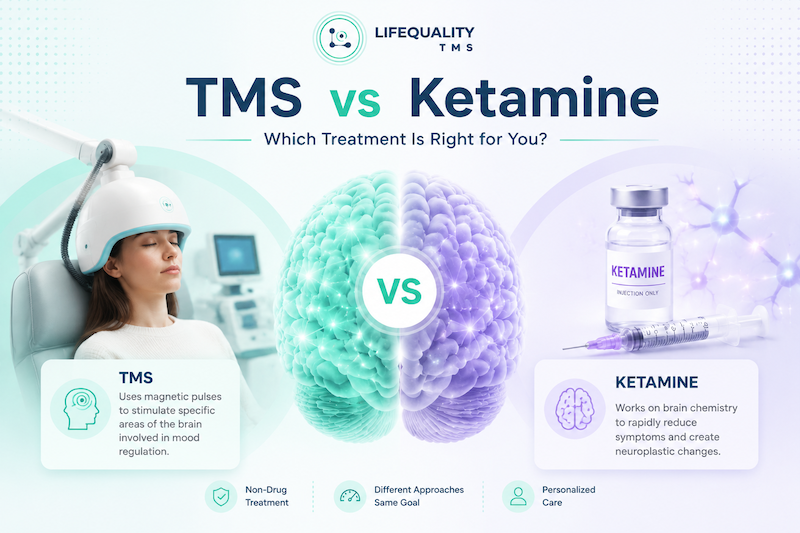
According to a systematic review and meta-analysis published in the Journal of Affective Disorders (Rakesh et al., August 2024), According to a naturalistic study published in PLOS ONE (PubMed, 2022), both TMS and intramuscular ketamine produced equally significant reductions in depression and anxiety symptoms in treatment-resistant patients, with no statistically meaningful difference in response or remission rates between the two groups.
Equal effectiveness, but very different experiences. TMS vs ketamine is one of the most common questions patients ask when medication has stopped working, and they are exploring what comes next. Both are legitimate, clinically supported options for treatment-resistant depression. They work through entirely different mechanisms, carry different side effect profiles, and suit different patients and situations.
The comparison below covers what you actually need to know before walking into a consultation.
TMS vs Ketamine at a Glance
| Factor | TMS | Ketamine |
| How it works | Magnetic pulses stimulate underactive brain circuits | Blocks NMDA receptors; triggers rapid neuroplasticity |
| Speed of relief | Typically weeks 2-4 of treatment | Hours to days after first infusion |
| Duration of benefit | 6-12+ months for most responders | Days to weeks; requires ongoing maintenance |
| FDA status | Cleared for MDD, OCD, anxious depression, smoking cessation | Esketamine (Spravato) FDA-approved; IV ketamine off-label |
| Side effects | Mild scalp discomfort, headache; no systemic effects | Dissociation, nausea, dizziness, blood pressure changes |
| Sedation required | None | Monitored setting required post-infusion |
| Addiction risk | None | Low in clinical settings; caution in substance use history |
| Insurance coverage | Broadly covered for qualifying diagnoses | Variable; esketamine more commonly covered than IV ketamine |
| Suitable for | Depression, OCD, anxiety; long-term relief | Acute crisis, suicidal ideation, rapid symptom relief |
How Does Each Treatment Work?
TMS: Rewiring the Brain Over Time
TMS uses a magnetic coil placed against the scalp to deliver focused pulses to the left dorsolateral prefrontal cortex, the brain region most consistently underactive in depression. Over a course of 20 to 30 sessions, repeated stimulation strengthens neural connections and promotes neuroplasticity, the brain’s ability to form new, healthier patterns of activity.
What does that mean practically for your daily life:
- No sedation before, during, or after sessions
- No recovery time: you can drive yourself and return to work immediately
- No systemic side effects: the magnetic field stays local and does not enter your bloodstream
- Sessions last 20 to 40 minutes, five days a week over four to six weeks
- FDA-cleared for depression, OCD, anxious depression, and smoking cessation.
Ketamine: Rapid Relief Through a Different Mechanism
Ketamine works by blocking NMDA receptors, which triggers a rapid release of glutamate and activates neuroplasticity pathways almost immediately. This is why ketamine can produce noticeable mood improvement within hours of a single infusion, sometimes within the same day.
Key things to know about the ketamine experience:
- Esketamine (nasal spray, brand name Spravato) is FDA-approved; IV ketamine is widely used off-label
- Both forms require administration in a medically supervised setting
- You cannot drive after a session: a monitored observation period of 60 to 120 minutes is required
- Effects are fast but not always lasting: most patients need ongoing infusions to maintain improvement
- Not suitable for patients with a history of psychosis, schizophrenia, or active substance use disorder.
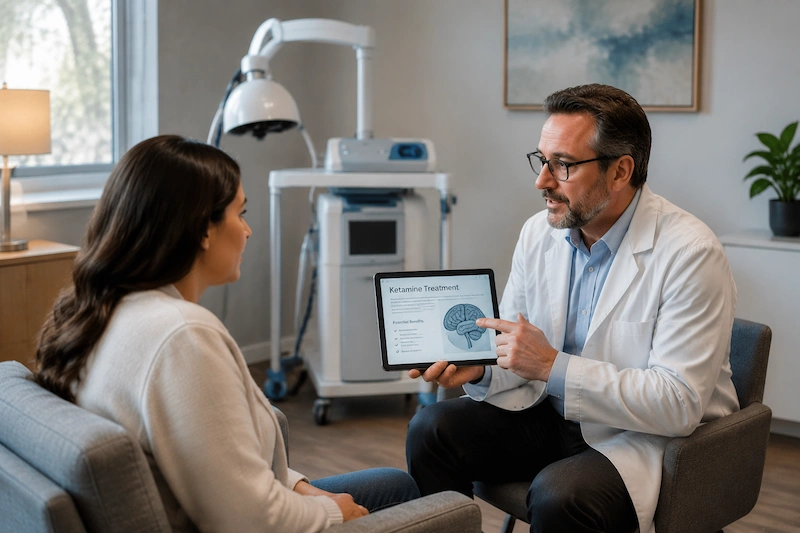
Ketamine vs TMS Effectiveness: What the Research Actually Shows
How Durable Are the Results?
This is where ketamine therapy vs TMS diverges most significantly in practice. Both can produce meaningful improvement. The difference is in how long that improvement lasts without ongoing treatment.
A critical 2025 narrative review published on Neurothérapie Montréal found that ketamine’s antidepressant effects typically last one to two weeks per infusion, with only 26% of patients still responding after six months of ongoing ketamine treatment. TMS, by contrast, produces response that is sustained in 45 to 62% of patients at 12 months, according to real-world registry data.
The practical implication: TMS tends to produce more durable results; ketamine tends to produce faster ones.
When Ketamine Has a Clear Advantage
One area where ketamine holds a specific, well-documented advantage is acute suicidal ideation. A 2024 systematic review and meta-analysis published in PubMed Central found that ketamine produced a large, clinically significant reduction in suicidal ideation across high-risk populations. TMS does not carry the same evidence base for acute suicidality, and would not typically be the first choice in a crisis presentation.
Side Effects: An Honest Comparison
What to Expect With TMS
TMS side effects are mild and self-limiting. The most common are scalp tingling or a mild headache, primarily in the first week of treatment, affecting roughly one third of patients and typically fading as sessions continue. There are no systemic side effects, no sedation, no impact on memory, and no withdrawal if treatment stops.
What to Expect With Ketamine
Ketamine’s side effect profile is more varied. According to a 2024 systematic review published in PubMed Central, the most commonly reported acute effects include dissociation, dizziness, nausea, blurred vision, and transient blood pressure elevation. These effects occur during and shortly after each infusion and resolve within the monitoring period, typically 60 to 120 minutes.
Long-term ketamine safety remains an open question. A 2025 PMC ethics review notes that uncertainty around long-term cognitive safety and the potential for dependence in patients with a substance use history are legitimate clinical considerations. Ketamine is generally not recommended for patients with a history of psychosis, schizophrenia, or active substance use disorder.
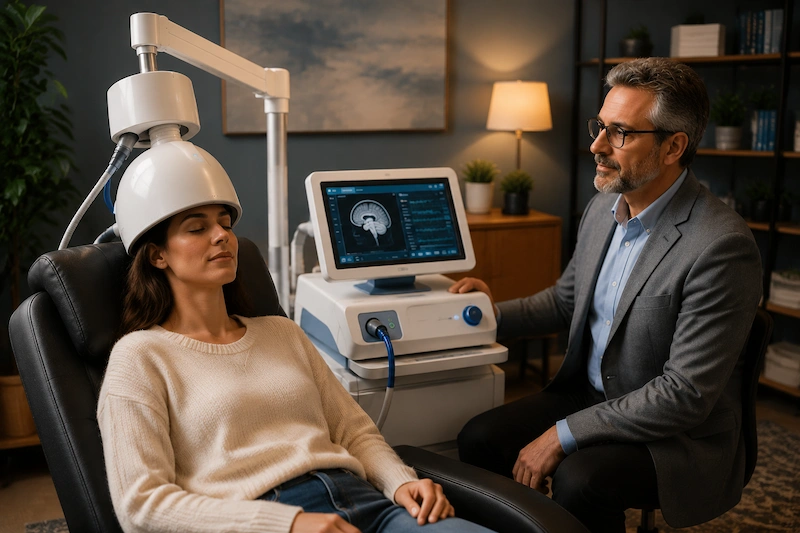
Can TMS and Ketamine Be Used Together?
What the Research Says About Combining Them
TMS and ketamine therapy used in combination is an active area of clinical research. The theoretical rationale is appealing: ketamine could provide fast, early relief while TMS produces durable, long-term changes.
The early evidence, however, is more cautious. A 2024 pilot study of more than 160 patients comparing ketamine and TMS simultaneously versus TMS alone found no significant difference in response or remission rates between the two groups, as reported in a ScienceDirect review published in 2026. The combination did not consistently add benefit over TMS alone. Larger randomized controlled trials are still needed before combining them can be considered standard practice.
A Sequential Approach
What is more commonly discussed in clinical practice is sequential rather than simultaneous use: ketamine or TMS first, then the other, based on how the patient responds. For a patient in acute crisis, ketamine first makes sense; its speed buys time. Once stabilized, TMS can then build durable improvement that ketamine alone does not sustain. Discussing the right sequence with your psychiatrist based on your specific history is the most evidence-aligned approach.
The Most Important Takeaway
TMS and ketamine are not competing treatments; they answer different clinical questions. Ketamine is fast and powerful in acute situations. TMS is durable and well-tolerated for long-term remission. The right choice, or the right sequence, depends on how severe your symptoms are right now, how long you need relief to last, and what else is in your clinical history.
If you are in Brooklyn or greater New York City and want a clinical evaluation to determine which approach is right for your situation, contact LifeQuality TMS to schedule a consultation. We serve patients from Brooklyn Heights, DUMBO, Fort Greene, Cobble Hill, and Boerum Hill, with easy access from Manhattan and Queens.
Frequently Asked Questions
What is the main difference between TMS and ketamine for depression?
TMS uses magnetic pulses to stimulate underactive brain circuits over a course of 20 to 30 sessions, producing durable relief over months. Ketamine works by blocking NMDA receptors to rapidly shift brain chemistry, producing fast relief that typically lasts days to weeks per treatment. TMS is better suited for long-term remission; ketamine is more appropriate when rapid symptom relief is the priority.
Which works faster, TMS or ketamine?
Ketamine works significantly faster. Many patients notice mood improvement within hours of their first infusion. TMS improvement typically begins in weeks two to four of a treatment course. For urgent symptom relief, including active suicidal ideation, ketamine has a documented advantage in speed and acute crisis response.
Should I try TMS or ketamine first?
This depends on the urgency of your symptoms, your medical history, and your treatment goals. For patients in acute crisis, ketamine may be more appropriate first. For patients seeking durable, long-term remission without systemic side effects, TMS is often the recommended starting point. A psychiatrist who knows your full history is the right person to make this determination with you.
Can TMS and ketamine be used at the same time?
Combining TMS and ketamine simultaneously is being studied, but current evidence does not show a consistent additive benefit over TMS alone. A sequential approach, using one after the other based on clinical response, is more commonly discussed in practice. This is an evolving area and worth raising specifically in your consultation.
Is TMS or ketamine covered by insurance?
TMS is broadly covered by most major insurers for qualifying diagnoses, primarily treatment-resistant depression and OCD. Esketamine (Spravato) has more consistent coverage than IV ketamine, which is often considered off-label and may require out-of-pocket payment. Confirming your specific coverage before beginning either treatment is an essential first step.
Is ketamine safe for long-term use?
Ketamine is generally well-tolerated in supervised clinical settings for acute treatment courses. Long-term safety is less well characterized, and caution is warranted for patients with a history of substance use disorder, psychosis, or cardiovascular conditions. TMS has a larger post-market safety record, with no systemic side effects identified over more than 15 years of clinical use.