
According to a comprehensive narrative review published in Brain Sciences (MDPI, November 2025), deep brain stimulation (DBS) demonstrates clinically meaningful symptom reductions across psychiatric conditions, with response and remission rates for depression approaching 48% and 35%, respectively, in patients who had already exhausted every other available treatment.
That context is everything. TMS vs DBS is a comparison between a non-invasive first-line treatment and a surgical procedure reserved for the most refractory cases. Understanding the difference helps patients figure out where they sit on that spectrum, and what the appropriate next step actually looks like.
TMS vs DBS Comparison at a Glance
| Factor | TMS | DBS |
| Procedure type | Non-invasive; no surgery | Invasive; requires neurosurgery |
| How it works | Magnetic pulses stimulate brain circuits through the scalp | Electrodes implanted in brain tissue deliver continuous electrical stimulation |
| Anesthesia required | None | General anesthesia |
| Recovery time | None; return to normal activity immediately | Hospital stay; weeks of post-surgical recovery |
| FDA status | Cleared for MDD, OCD, anxious depression, smoking cessation | Cleared for OCD and movement disorders; investigational for depression |
| Reversibility | Fully reversible; no hardware | Partially reversible; hardware removal carries its own risk |
| Side effect profile | Mild scalp discomfort, headache; no systemic effects | Surgical risks including hemorrhage, infection, hardware failure |
| Typical cost | Covered by most major insurers for qualifying diagnoses | $30,000-$100,000+; coverage varies considerably |
| Who it is for | Adults with depression, OCD, or anxiety not responding to medication | Severe, refractory cases after all other treatments have failed |
Deep Brain Stimulation vs TMS: How Does Each Treatment Work?
TMS: Stimulating the Brain Without Entering It
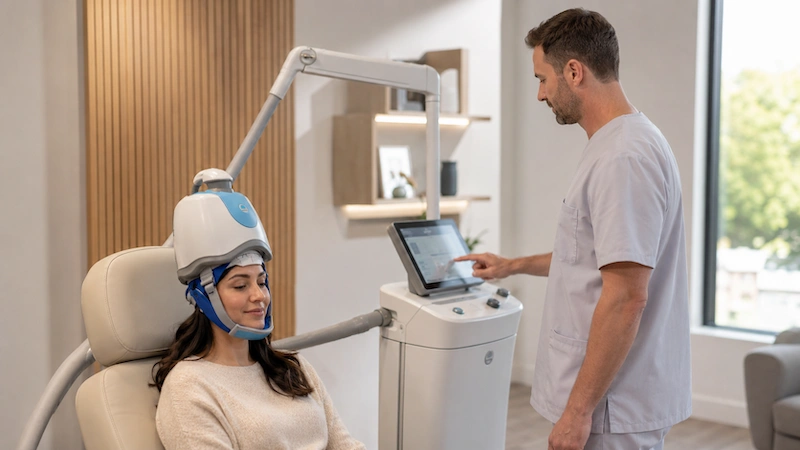
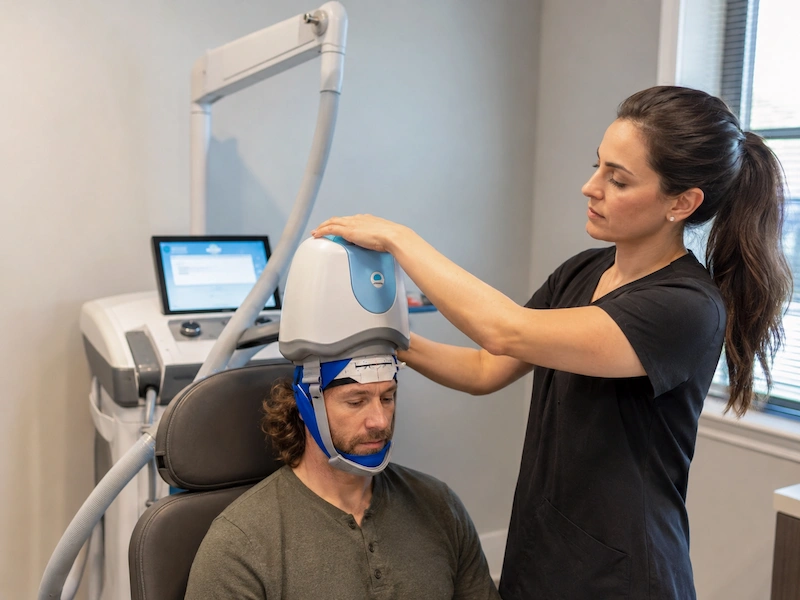
TMS stands for transcranial magnetic stimulation. It uses a coil placed gently against the scalp to send focused magnetic pulses through the skull to specific brain regions, most commonly the prefrontal cortex for depression and the anterior cingulate cortex for OCD. The pulses promote neuroplasticity, encouraging underactive circuits to fire more efficiently and build stronger neural connections over time.
What a TMS course looks like in practice:
- One session per day, five days a week, for four to six weeks
- Each session lasts 20 to 40 minutes; no preparation or fasting required
- No sedation: you remain fully awake and alert throughout
- You can drive yourself home immediately and return to work the same day
- No drugs, no implants, nothing enters your body
The evidence base for TMS is extensive. A 2025 consensus review of nearly 2,400 studies confirmed that TMS is safe and effective even in medication-resistant populations, with up to 83% of patients showing measurable improvement in real-world settings.
DBS: Surgical Stimulation of Deep Brain Structures
Deep brain stimulation involves a neurosurgeon implanting thin electrodes into specific deep regions of the brain, typically the subcallosal cingulate cortex for depression or the anterior limb of the internal capsule for OCD. The electrodes connect via wires under the skin to a small pulse generator implanted near the collarbone, similar to a cardiac pacemaker. The device delivers continuous, adjustable electrical stimulation to the targeted brain region.
DBS can reach brain structures that TMS cannot access, which is its primary clinical advantage. Stimulation parameters can be adjusted externally after implantation, and the device can be turned off if needed. However, removing the hardware entirely is itself a surgical procedure and is not without risk.
An estimated 244,000 DBS devices have been implanted globally as of recent data, primarily for movement disorders like Parkinson’s disease, according to a Frontiers in Aging Neuroscience systematic review (2023). Its psychiatric applications, particularly for depression, remain investigational in the United States.
What Are the Real Risks of DBS?
Surgical Complications: What the Data Shows
This is the most important section for any patient comparing DBS vs TMS. DBS is not a more intensive TMS: it is a neurosurgical procedure with a distinct risk profile that needs to be weighed honestly.
A systematic review of DBS complications across 519 cases over 20 years, published in ScienceDirect, reported the following complication rates:
- Infection: 4.2% of cases
- Hemorrhage: 2.4% of cases
- Lead malposition: 3.3% of cases
- Hardware-related complications: 2.4% of cases (including lead fracture and device malfunction)
- Revision surgery required: 4.9% of cases
A separate long-term analysis of 426 DBS patients published in PMC reported a 0.5% mortality rate directly related to surgical or anesthetic complications.
By comparison, TMS has no surgical risks. Its side effect profile across clinical trials and post-market surveillance shows nothing beyond transient scalp discomfort and mild headache, with less than 5% of patients discontinuing treatment due to side effects.
What “Reversible” Actually Means for DBS
DBS is often described as reversible because the stimulation can be turned off and, in theory, the hardware removed. In practice, reversibility is partial. Turning off the device is simple. Removing implanted electrodes from brain tissue is a surgical procedure in its own right, carrying its own hemorrhage and infection risk. This is not a reason to categorically avoid DBS for the right patient, but it is something to understand clearly before consenting to implantation.
Is Deep Brain Stimulation Without Surgery Possible?
Patients who ask about deep brain stimulation without surgery are often responding to TMS’s depth limitation: standard TMS reaches approximately one to two centimeters below the scalp, and deep TMS (using the BrainsWay H-coil) reaches two to three centimeters. True deep brain structures lie four to six centimeters below the surface.
Focused ultrasound is the most advanced non-invasive method currently being studied for deep brain targeting. It uses ultrasound waves to modulate neural activity at depths that TMS cannot reach. It is not yet FDA-cleared for psychiatric indications, but research is active. A PMC review on noninvasive deep brain stimulation methods describes focused ultrasound, temporal interference stimulation, and other emerging technologies as the next generation of neuromodulation.
For now, patients seeking non-invasive options are best served by TMS, which has 15 years of post-clearance clinical data behind it. The non-invasive alternatives to surgery are genuinely promising, but not yet part of standard clinical practice.
Who Should Consider TMS vs DBS?
The clinical logic for choosing between them follows a clear sequence:
- Start with TMS. It is FDA-cleared, covered by insurance, carries no surgical risk, and produces meaningful improvement in 60 to 83% of patients with treatment-resistant depression and OCD. It is where the evidence-based pathway begins for the vast majority of patients.
- Consider DBS only after TMS and other established treatments have failed. DBS for depression is still investigational in the U.S. For OCD, it is FDA-cleared but reserved for severe cases. The standard clinical threshold involves failing multiple medication trials, adequate therapy, and at least one course of TMS before DBS is seriously evaluated.
- Discuss DBS with a specialist, not as a first step. DBS programs are concentrated at academic medical centers and require multidisciplinary evaluation. This is a treatment that a neurosurgical team determines appropriate after extensive review.
TMS vs DBS: Different Points of the Same Ladder
TMS and DBS represent different points on the treatment ladder. TMS is the clinically validated, insurance-covered, surgically risk-free starting point for most people with treatment-resistant depression or OCD. DBS is a neurosurgical intervention for the small subset of patients who have not responded to any of those options. For almost everyone reading this article, TMS comes first.
If you are in Brooklyn or greater New York City and want to understand whether TMS is the right next step for your situation, contact LifeQuality TMS to schedule a consultation.
Frequently Asked Questions
What is the main difference between TMS and DBS?
TMS is a non-invasive outpatient treatment that uses magnetic pulses to stimulate brain circuits through the scalp, with no surgery, no anesthesia, and no recovery time. DBS is a neurosurgical procedure that implants electrodes directly into deep brain tissue, connected to a pulse generator under the skin. TMS is the evidence-based first step for depression and OCD; DBS is reserved for cases that have not responded to any other treatment.
Is deep brain stimulation more effective than TMS?
Not necessarily, and certainly not for patients who have not yet tried TMS. DBS response rates for depression reach approximately 48% in highly refractory populations. TMS produces meaningful improvement in 60 to 83% of patients with treatment-resistant depression in real-world settings. DBS can reach deeper brain structures, but for the conditions TMS is cleared to treat, it does not consistently outperform TMS and carries significantly greater risk.
Can you get deep brain stimulation without surgery?
Not currently with available clinical options. Focused ultrasound and temporal interference stimulation are being studied as non-invasive ways to reach deep brain targets, but none are FDA-cleared for psychiatric use yet. TMS and deep TMS represent the furthest non-invasive penetration available in clinical practice today. For patients seeking a drug-free, surgery-free option, TMS is the appropriate choice.
What are the surgical risks of DBS?
Published data from hundreds of DBS cases identifies infection in approximately 4.2% of procedures, hemorrhage in 2.4%, hardware failure in 2.4%, and revision surgery in approximately 4.9%. A 21-year longitudinal study reported a 0.5% mortality rate from surgical or anesthetic complications. These rates are relatively low for a neurosurgical procedure, but they are meaningfully different from the side effect profile of TMS, which involves no surgical risk.
Is DBS covered by insurance?
DBS is FDA-cleared for OCD and movement disorders like Parkinson’s disease, and insurance coverage for those indications exists but varies by plan. For depression, DBS remains investigational in the U.S. and is generally not covered. TMS, by contrast, is broadly covered by major insurers for qualifying depression and OCD diagnoses, making it the more accessible option for the vast majority of patients.
Who is a good candidate for DBS for depression or OCD?
DBS for OCD is typically considered for adults with severe, chronic OCD who have failed multiple medication trials, intensive behavioral therapy, and at least one other neuromodulation treatment such as TMS. For depression, which remains investigational, the threshold is similarly high. A multidisciplinary evaluation at a specialized center is required. Most patients exploring their options have not yet reached this threshold and are better served beginning with TMS.