Short answer: Most people who respond to TMS notice small, quiet shifts before anything dramatic happens – sleeping a little easier, getting through a morning without dread, answering a text instead of letting it sit. These changes usually show up between weeks two and four, often before mood itself feels different. So if you’re trying to figure out whether treatment is taking hold, look for small, steady changes in daily function and energy rather than waiting for a single moment when everything clicks.
TMS doesn’t flip a switch. It nudges the brain, session after session, and the brain takes its time catching up. Below, we’ll walk through what’s happening inside your head during those early weeks, what changes show up first, what it means if nothing seems to be happening yet, and how to track progress in a way that makes sense.
How TMS Works in the Brain Before You Notice Changes
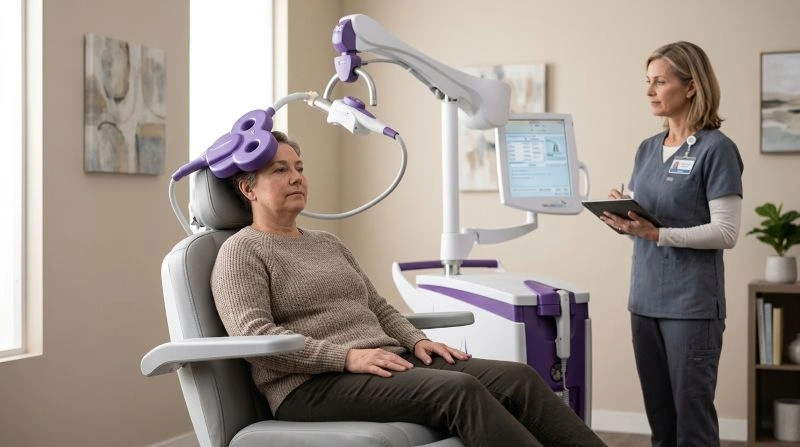
Transcranial magnetic stimulation targets the prefrontal cortex, the part of the brain involved in mood regulation, motivation, and decision-making. Each session sends magnetic pulses through this region, encouraging nerve cells to fire differently than they have been.
This isn’t an instant fix. The brain responds to repeated stimulation through neuroplasticity – building and strengthening new pathways over time, less like flipping a light switch and more like wearing a new path into a field. The first steps don’t look like much; after enough repetition, the path becomes obvious.
- Stimulation begins. Magnetic pulses reach the prefrontal cortex and nearby circuits during each session.
- Neural activity shifts. Nerve cells start firing and connecting in slightly different patterns, often within the first one to two weeks.
- New pathways strengthen. With repetition, these altered firing patterns become more stable, which is the neuroplastic change researchers track on brain scans.
- Symptoms start to catch up. Only after this groundwork is laid does mood, energy, or motivation begin shifting in ways a patient can actually notice.
There’s also a lag between what’s happening biologically and what you actually feel. Brain circuits can begin adjusting before your conscious experience of mood catches up. A 2024 study in the Journal of Affective Disorders followed patients receiving rTMS for depression and found that early shifts in specific symptoms – particularly initiative and emotional engagement – predicted how well people would respond by the end of treatment. The small stuff that happens early often says more than how you feel in week one.
A separate 2024 analysis from the University of Iowa, covering both rTMS and theta-burst protocols, found that even a 10% improvement in symptom scores by the tenth session carried real predictive weight. That’s a modest number, and exactly the kind of shift that’s easy to dismiss – but it’s a good early hint at how to know if TMS is working before mood itself has visibly shifted. If you’re curious how theta-burst protocols differ from standard sessions, LifeQuality TMS’s breakdown of rapid TBS protocols covers the mechanics in more detail.
Behavioral Changes That Suggest TMS Is Working
Because the brain often moves before mood does, behavior tends to be one of the more reliable early markers. Patients and the people around them frequently notice these shifts before the patient consciously feels “better.” Here’s what commonly shows up in the early-to-middle weeks:
- More consistency in daily routines. Getting up at a regular time, eating meals, showering – the basic structure of a day holds together with less effort.
- More follow-through on tasks. Things that used to get postponed indefinitely – replying to emails, finishing chores – start getting done, even without much enthusiasm.
- Increased willingness to communicate. Conversations that felt like a burden become manageable, and some people start initiating contact instead of just responding.
- Reduced social withdrawal. Skipping plans becomes less automatic, and saying yes feels less impossible.
- A flicker of interest in old hobbies. Not full enthusiasm, just a willingness to pick something up again.
- More stable sleep and energy. Sleep that’s less erratic, energy that doesn’t crash as hard by mid-afternoon.
None of this needs to look like joy. Often it looks more like reduced resistance – things that used to take enormous effort now take ordinary effort. For many patients, that shift in effort is the clearest answer to how do you know if TMS is working, even before mood catches up.
Signs TMS Is Not Working Yet (or Needs Adjustment)
A brief flatline in the first week or two is normal. It doesn’t tell you much about how to know if TMS is working for you specifically – that picture needs a few more weeks to form.
When It’s Worth Raising With Your Provider
There’s a difference between “nothing yet” and “this protocol isn’t fitting.” A few patterns are worth flagging:
- No movement after several weeks. If functioning, mood, and energy are still flat by the four-to-five week mark, with zero fluctuation, that’s worth a conversation.
- A consistently severe low mood with no variability. Mood doesn’t need to be good yet, but some day-to-day variability usually signals a response in progress.
- No change in energy or motivation whatsoever. Even small fluctuations – a slightly easier Tuesday, a harder Thursday – suggest the system is being affected.
- Symptoms getting worse rather than better. This always warrants a clinical review, not a wait-and-see approach.
If any of these show up, it doesn’t automatically mean TMS has failed. Providers often adjust the protocol itself – refining the stimulation target, adjusting pulse intensity, or modifying session frequency – before concluding a different approach is needed.

A UCLA Health study tracking 708 patients found that relying on a single rating scale could miss up to a third of genuine treatment responses, since different scales pick up different symptom clusters at different speeds. That’s a strong argument against snap judgments based on one bad week. For more on what to expect session by session, LifeQuality TMS’s FAQ page answers common questions about timelines and what counts as a typical response.
What Patients Should Pay Attention To (Real-World Guide)
This is where most people get tripped up – scanning for a dramatic turnaround and missing the quieter signals that are there.
Focus on Small Shifts, Not Big Ones
Instead of asking “do I feel completely different,” it helps to ask smaller questions:
- Was this morning slightly easier than last week’s?
- Does the emotional weight feel marginally lighter?
- Did I do something today I would have avoided two weeks ago?
These small data points add up, and they’re far more realistic than expecting a single threshold moment.
Track Patterns, Not Single Days
A mood journal or simple daily rating (even a 1-10 scale jotted each evening) beats relying on memory. The goal isn’t a perfect score – it’s noticing whether the pattern drifts upward over two or three weeks, even with bad days mixed in. This is one of the more reliable ways to answer how do you know if TMS is working without overreacting to a single rough day.
Notice Reduced Resistance to Activity
Pay attention to friction, not just feeling. If getting out of bed, answering a message, or going for a short walk takes noticeably less effort than a month ago, that’s meaningful – even if your mood rating hasn’t moved much. Reduced resistance to activity is one of the quieter signs TMS is working, often showing up before mood catches up.
The Bottom Line on Early TMS Progress
TMS works through gradual, repeated stimulation that reshapes brain activity over time, not through a single dramatic turning point. The earliest evidence of progress is usually quiet: a slightly easier morning, less emotional heaviness, a small task completed without the usual dread. These signs show up across emotional, cognitive, and behavioral domains, worth tracking as a pattern rather than judging in isolation.
If you’re trying to figure out how to know if TMS is working, watch for small, consistent shifts over weeks rather than waiting for one unmistakable moment. If those shifts aren’t showing up after a reasonable stretch, that’s worth bringing to your provider – not a sign to quietly give up. For a closer look at how treatment protocols can be sped up when patients want to see results faster, LifeQuality TMS’s piece on accelerated TMS walks through how condensed schedules compare to standard ones, and the TMS for depression page outlines what a typical course of treatment looks like from evaluation to completion.
Frequently Asked Questions
How do I know if TMS is working early on?
Look at function and energy before mood. In the first two to three weeks, many people notice small things – easier mornings, more willingness to engage with tasks or people – before feeling genuinely happier.
How to know if TMS is working during treatment?
Track consistency over time rather than judging any single day. By the midpoint of a treatment course, many patients can see a gradual upward drift in mood stability, energy, or engagement, even with day-to-day fluctuations.
What are the main signs TMS is working?
The clearest signs TMS is working usually fall into three categories: behavioral (more consistent routines, less withdrawal, returning interest in activities), physical (steadier sleep and energy), and emotional (mood swings becoming less extreme). Changes across more than one category are a stronger signal than a shift in just one.
How long does it take before you can tell if TMS is working?
Many providers point to roughly the two-to-four-week mark, often around the tenth session, as a meaningful checkpoint. Some patients notice changes earlier; a portion are identified as faster responders within the first two weeks. A full course typically runs longer, so early signs are a checkpoint, not a final verdict.
What if I don’t notice any changes during TMS?
If several weeks pass with no fluctuation at all in mood, energy, or daily functioning, it’s worth raising with your provider. This doesn’t necessarily mean treatment has failed – protocols can often be adjusted, including the stimulation target or session structure. If you’re still wondering how to know if TMS is working at that point, a conversation with your provider is the right next step.
THE TEXT IS ONLY INFORMATIONAL; FOR FURTHER TREATMENT, CONSULT A DOCTOR