Theta burst stimulation is changing what mental health treatment looks like – not by being louder or more aggressive, but by being smarter and faster. For people managing depression, anxiety, OCD, or PTSD, knowing how this technology works can be the difference between seeking help and staying stuck. This article breaks down what TBS is, how it works inside the brain, what a session actually looks like, and why it has become one of the most talked-about tools in modern neuromodulation.
What Is Theta Burst Stimulation?
Theta burst stimulation is a specialized form of transcranial magnetic stimulation (TMS) that delivers focused magnetic pulses to specific regions of the brain. What sets it apart from traditional TMS isn’t the underlying technology – both use magnetic fields to activate cortical neurons – but rather the pattern in which those pulses are delivered.
Standard TMS sends pulses at a steady 10 Hz rhythm for sessions that typically run 37 to 45 minutes. TBS, by contrast, delivers rapid three-pulse bursts at 50 Hz, grouped and repeated at 5 Hz intervals. The result is a much denser and more neurologically targeted form of stimulation – and sessions that clock in at around three minutes.
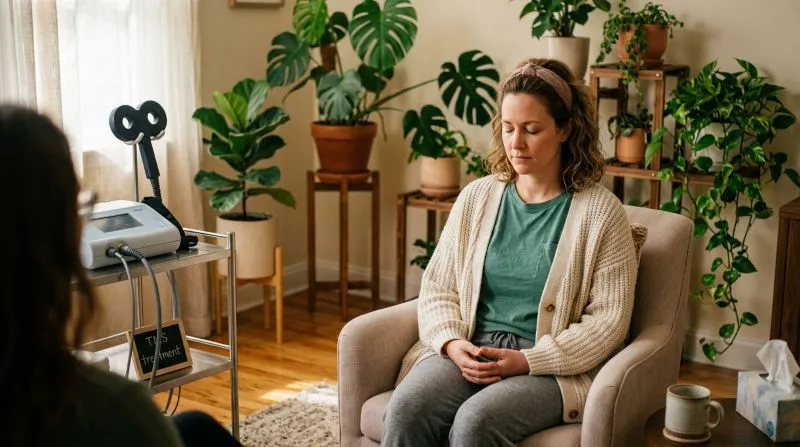
Intermittent theta burst stimulation (iTBS) received FDA clearance in 2018 for the treatment of major depressive disorder. It is non-invasive, requires no anesthesia, and carries no systemic side effects tied to medications. Patients remain awake and seated throughout the entire procedure.
Beyond depression, TBS is used in clinical settings to address:
- Anxiety disorders, including generalized anxiety and social anxiety
- Obsessive-compulsive disorder (OCD)
- Post-traumatic stress disorder (PTSD)
- Treatment-resistant depression in patients who haven’t responded to antidepressants
Learn more about the conditions treated at LifeQuality TMS.
How Rapid TBS Differs From Traditional TMS
The distinction between theta burst stimulation vs TMS goes beyond timing – the two protocols affect the brain in subtly different ways and serve different patient needs.
Protocol Duration
This is where the gap is most obvious. A standard TMS session runs approximately 37 to 45 minutes per visit, across 20 to 30 sessions. A TBS session typically takes three minutes, with a comparable total treatment course. For patients juggling work, childcare, or long commutes, this difference isn’t trivial – it can determine whether someone completes a full treatment course or drops off midway.
Frequency and Intensity
While both treatments stimulate the same target brain regions, TBS does so using a pattern that mirrors the brain’s natural theta rhythms.
Traditional TMS applies 10 Hz repetitive stimulation at 110–120% of the patient’s motor threshold. TBS delivers pulses at 50 Hz within three-pulse bursts, repeated at 5 Hz – a pattern that aligns more closely with how neurons naturally fire during memory encoding and mood regulation. This mimicry of endogenous brain rhythms is thought to make the stimulation more efficient at inducing synaptic change.
Clinical Advantages
Beyond speed, clinical settings have noted consistent advantages with TBS protocols:
- Reduced chair time – meaningful for busy clinics and patients with limited schedules
- Comparable tolerability – reported side effects are similar to, or milder than, standard TMS
- Scalability – shorter sessions make it feasible to offer accelerated multi-session protocols within the same week
TBS vs TMS: Side-by-Side Comparison
Feature | Standard TMS (10 Hz) | Theta Burst Stimulation |
Session duration | ~37–45 minutes | ~3 minutes |
Total pulses per session | 3,000 | 600 |
FDA clearance (depression) | 2008 | 2018 |
Typical treatment course | 20–30 sessions | 20–30 sessions |
Mechanism | Steady-rate stimulation | Burst-pattern, theta-mimicking |
Side effects | Mild headache, scalp discomfort | Comparable; often milder |
A 2024 randomized clinical trial published in JAMA Psychiatry examined accelerated intermittent theta burst stimulation (aiTBS) in patients with treatment-refractory bipolar depression. Participants who received aiTBS showed significantly lower depression scores after treatment compared to the sham group, reinforcing earlier evidence that TBS protocols produce meaningful clinical benefit – even in difficult-to-treat populations.
How Theta Burst Stimulation Works in the Brain
The mechanism behind theta burst stimulation TMS isn’t magic – it’s synaptic biology. When magnetic pulses reach the dorsolateral prefrontal cortex (DLPFC), the electromagnetic field induces small electrical currents in cortical neurons. Those neurons fire, and with repeated stimulation, their connections either strengthen or weaken depending on the protocol used.
Intermittent TBS (iTBS) promotes long-term potentiation – a strengthening of synaptic connections tied to improved mood regulation. Continuous TBS (cTBS) has the opposite effect, suppressing local activity in overactive brain regions. For mood and anxiety disorders, iTBS applied to the left DLPFC is the most common approach, targeting a region consistently linked to emotional processing and executive function.
What this looks like over time: after a single session, brain activity in the targeted region shifts measurably. After a full treatment course – typically 20 or more sessions – those cumulative synaptic changes begin to translate into real symptom relief. The brain doesn’t reset overnight. The effects build the way physical rehabilitation builds strength – through repeated, directed effort.
That mechanism was put to a rigorous test in a 2025 triple-blinded randomized clinical trial published in JAMA Psychiatry (Ramos, Goerigk, Brunoni et al.). The TTT trial enrolled 100 adults with treatment-resistant depression, delivering three iTBS sessions per day over 15 days – 45 sessions total.
The active aTBS group saw a 54.7% reduction in depression severity, compared to 31.87% in the sham group, with a medium-to-large effect size (Cohen’s d = 0.65). The most common side effect was mild scalp discomfort, reported in just 17.4% of active participants. These results point to a meaningful dose-response relationship: when TBS is applied more intensively within a structured protocol, the neuroplastic benefits compound accordingly.
For a deeper look at how TMS protocols are structured at LifeQuality TMS, visit the for patients page.
Preparing for Your Theta Burst Stimulation Treatment
Understanding the mechanics is one thing. Knowing what to expect in a clinical setting is another.
Initial Evaluation
Before any theta burst stimulation TMS session begins, patients undergo a thorough intake evaluation. This covers psychiatric history, current medications (some drugs affect seizure threshold and may need adjustment), and a neurological screening. Motor threshold testing – identifying the minimum stimulation intensity needed to produce a motor response – calibrates the equipment precisely to each patient.
During the Session
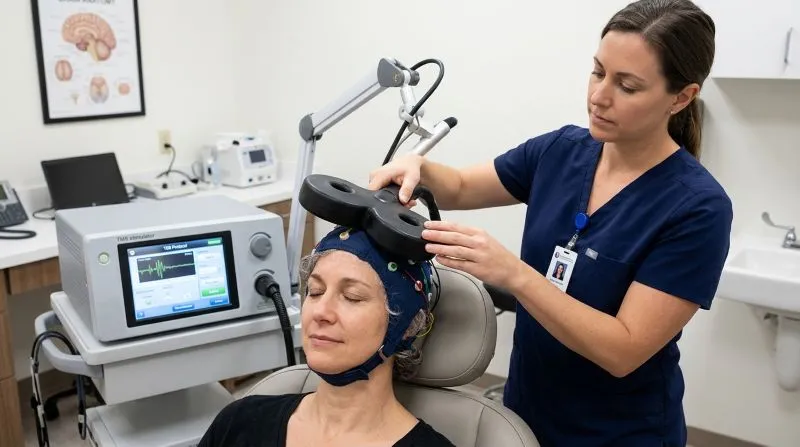
Patients sit in a reclining chair while a treatment coil is positioned over the scalp, targeting the relevant cortical region. The session itself is brief – most iTBS protocols deliver 600 pulses in under four minutes. Patients stay fully awake and can typically drive themselves home right after. Some report mild scalp tingling or a light headache during early sessions, both of which tend to ease as treatment progresses.
Post-Treatment Guidance
There are no restrictions after a TBS session. Clinicians generally recommend:
- Maintaining a consistent sleep schedule throughout the treatment course
- Limiting alcohol, which may blunt the brain’s neuroplastic response
- Tracking mood between sessions so the clinical team can monitor progress and make adjustments when needed
Ongoing communication with the treating clinician matters here. Response varies between patients, and individualized adjustments in timing or intensity can make a real difference. The LifeQuality TMS FAQ page covers more on what to expect during and after treatment.
Why Rapid TBS Protocols Are Shifting Mental Health Care
The move toward shorter, more targeted treatment protocols reflects a broader shift in how mental health care is delivered – one that takes seriously the practical barriers patients face. Theta burst stimulation offers clinical outcomes comparable to conventional TMS in a fraction of the time, without sacrificing safety or tolerability.
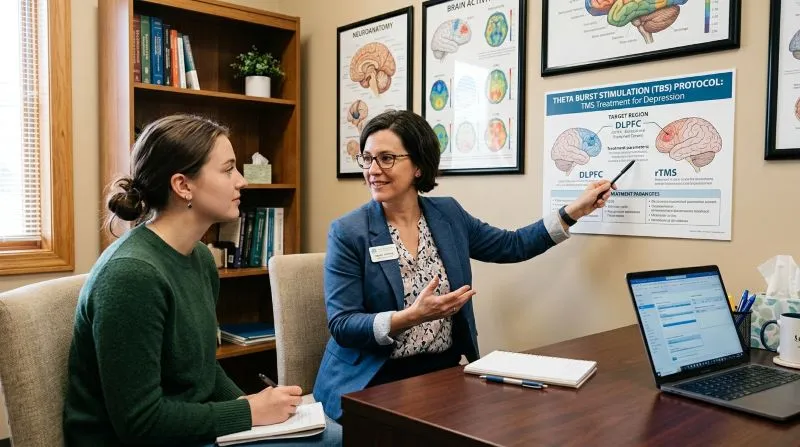
For patients who have spent months or years trying medication combinations with limited relief, TBS represents a different kind of option – not a last resort, but a clinically sound, evidence-backed tool that addresses the neurological underpinnings of mood disorders directly. When combined with thoughtful evaluation, ongoing monitoring, and individualized planning, rapid TBS protocols give patients a real path forward.
If you’re exploring whether theta burst stimulation is the right fit for your situation, the team at LifeQuality TMS is available to walk through your history, answer questions, and help determine what treatment could look like for you.
Frequently Asked Questions
Is theta burst stimulation painful?
Most patients describe it as mild discomfort – a light tapping sensation on the scalp. Some notice a slight pressure or warmth at the treatment site. Any sensitivity typically decreases after the first few sessions as the scalp adjusts.
How many sessions are needed before results appear?
Many patients notice mood shifts within the first one to two weeks. Others experience more gradual improvement across the full treatment course of 20 to 30 sessions. Response depends on individual factors like depression severity and treatment history, so clinical teams monitor progress throughout and can adjust the plan when needed.
Can TBS be used alongside antidepressant medication?
Yes, in most cases. TBS and antidepressants are not mutually exclusive, and many patients receive both concurrently without issue. The treating psychiatrist will review current medications during the intake evaluation to check for any contraindications before proceeding with treatment.
Who is not a good candidate for TBS?
People with a history of epilepsy, metallic implants near the head (such as cochlear implants or aneurysm clips), or certain active neurological conditions may not be eligible. A full medical screening covers these factors before treatment begins, ensuring TBS is both safe and appropriate for each individual.
Does the effect of TBS last after the course ends?
For many patients, the antidepressant effects persist for weeks to months after completing treatment. Periodic booster sessions are sometimes recommended when symptoms begin to return. The durability of results can vary, and long-term outcome data continues to grow as TBS sees broader clinical use.