According to a 2025 consensus review endorsed by the National Network of Depression Centers, drawing on nearly 2,400 studies, TMS is safe and effective even for individuals whose depression has not responded to medications, with up to 83% of patients showing measurable improvement in real-world clinical settings.
That figure sits at the non-invasive end of a much broader landscape. Brain stimulation technology now spans a wide spectrum, from outpatient magnetic pulse treatments you can walk away from in 20 minutes, to surgical procedures involving electrodes implanted directly into brain tissue. Most patients researching their options encounter these terms without much context for what separates them.
This article explains the main brain stimulation techniques, how each one works, who each one is designed for, and where the evidence stands, written for patients.
Brain Stimulation Options at a Glance
| Method | Invasive? | Anesthesia? | FDA Status | Best Known For |
| TMS | No | No | Cleared: MDD, OCD, anxious depression, smoking cessation | Depression, OCD, anxiety |
| Deep TMS (dTMS) | No | No | Cleared: MDD, OCD | OCD, treatment-resistant depression |
| tDCS | No | No | Not cleared for psychiatric use | Research; cognitive applications |
| ECT | No (but systemic) | Yes (general) | Cleared | Severe, acute depression |
| VNS | Yes (implant) | Yes (surgery) | Cleared for TRD | Treatment-resistant depression |
| DBS | Yes (implant) | Yes (surgery) | Cleared for OCD, Parkinson’s | Severe OCD, movement disorders |
How Does Brain Stimulation Work?
The Core Principle Behind All Methods
All brain stimulation methods share one underlying idea: targeted stimulation of neural circuits can change how those circuits function. Depression, OCD, and anxiety all involve identifiable patterns of underactivity or overactivity in specific brain regions. By targeting those regions with electrical, magnetic, or other forms of energy, it is possible to shift activity in a therapeutic direction, encouraging the brain to build new, healthier patterns through neuroplasticity.
What differs across methods is how deep the stimulation reaches, whether it requires surgery, and how precisely it can be targeted.
Why Non-Invasive Methods Have Become the First Choice
Non-invasive brain stimulation has expanded dramatically over the past two decades for a straightforward reason: it produces meaningful clinical results without the risks that come with surgery, anesthesia, or implanted hardware. A 2023 editorial in Frontiers in Systems Neuroscience noted that non-invasive stimulation techniques are now among the main therapeutic prospects of modern neurology and psychiatry, covering a range from TMS and tDCS to vagal nerve stimulation and focused ultrasound.
For most patients dealing with depression, anxiety, or OCD, the non-invasive tier is where treatment begins and often ends.
Non-Invasive Brain Stimulation: What Your Options Are
TMS and Deep TMS: The Most Widely Used Methods
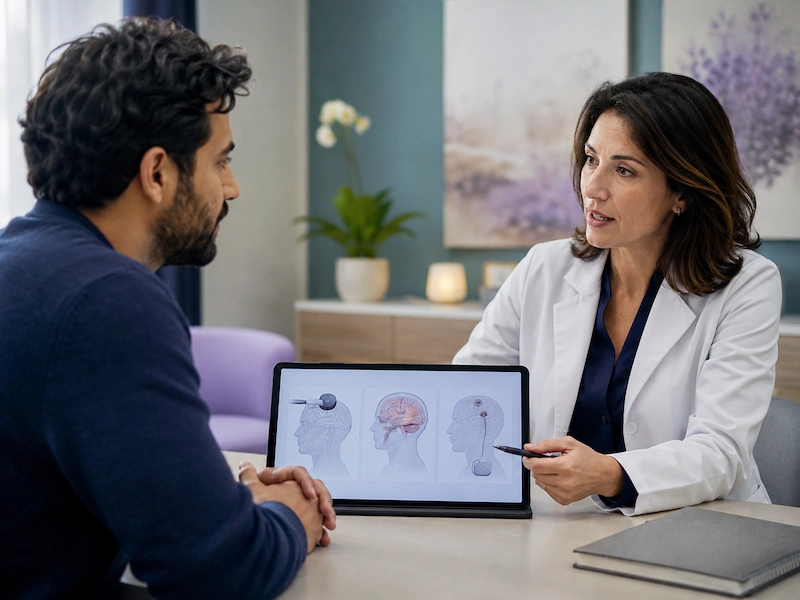
External brain stimulation with TMS works by placing a magnetic coil against the scalp. The coil delivers focused magnetic pulses that pass painlessly through the skull and stimulate targeted brain circuits, most commonly the prefrontal cortex for depression and the anterior cingulate cortex for OCD.
TMS is the most extensively studied non-invasive psychiatric brain stimulation method, with FDA clearances earned through large randomized controlled trials. Deep TMS, which uses a specialized H-coil, reaches brain regions roughly two to three centimeters deeper than standard TMS coils, giving it specific applicability to OCD.
What makes TMS the starting point for most patients considering brain stimulation:
- No surgery, no anesthesia, no recovery time
- No drugs enter the body at any point
- FDA-cleared for depression, OCD, anxious depression, and smoking cessation
- Sessions last 20 to 40 minutes; patients drive themselves home immediately after
- Side effects are mild and transient: most commonly a brief scalp tingling in the first week
- Covered by most major insurance plans for qualifying diagnoses.
tDCS: A Research Tool, Not Yet a Clinical Standard
Transcranial direct current stimulation (tDCS) uses low-level electrical current delivered through electrodes on the scalp to modulate neural excitability. It is inexpensive and non-invasive, which has made it popular in research settings. However, tDCS does not yet have FDA clearance for any psychiatric indication. Its effects are more diffuse and less targeted than TMS, and the clinical evidence for depression and anxiety is considerably thinner. It is worth knowing about, but not yet a first-line option for most patients.
ECT: Effective but a Different Category Entirely
Electroconvulsive therapy (ECT) does not involve surgical implantation, but it is meaningfully different from TMS and tDCS. ECT requires general anesthesia, deliberately induces a controlled seizure, and involves a recovery period of one to two hours per session due to anesthesia effects. Temporary memory disruption is a well-documented side effect.
ECT is the most effective brain stimulation treatment available for severe depression, and it works faster than TMS. It is most appropriate for patients in acute psychiatric crisis where rapid response is critical. For the majority of patients exploring brain stimulation for the first time, ECT is typically not the starting point.
Invasive Brain Stimulation: When Surgery Enters the Picture
Vagus Nerve Stimulation (VNS)
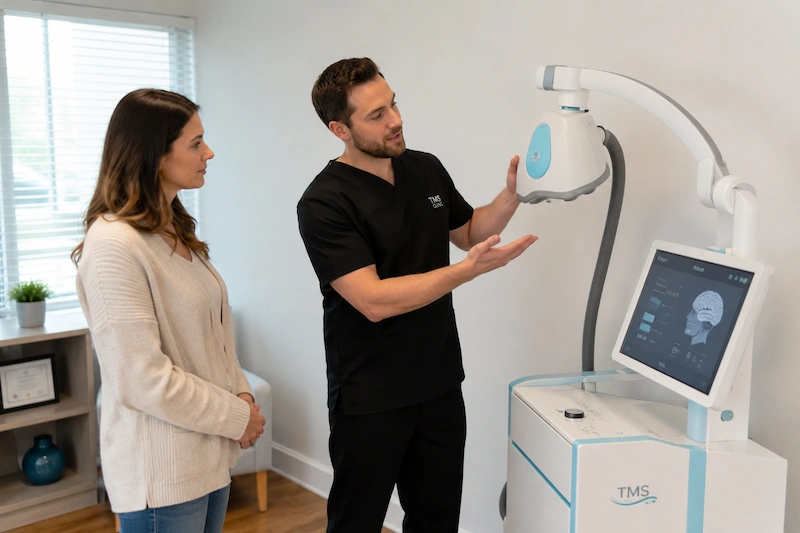
VNS involves surgically implanting a small device near the collarbone that sends electrical pulses to the brain via the vagus nerve. It received FDA clearance for treatment-resistant depression in 2005. Response rates in TRD populations are meaningful over time, but VNS requires surgery, a general anesthetic, and several months before its full effect becomes apparent. It is typically considered only after multiple other treatments, including TMS and medication, have not produced adequate results.
Deep Brain Stimulation (DBS)
DBS involves neurosurgeons implanting electrodes directly into specific deep brain structures. It is FDA-cleared for OCD and for movement disorders like Parkinson’s disease, and is being studied for depression. A 2025 systematic review on medRxiv noted that DBS demonstrates response rates of 40 to 70% in treatment-resistant populations, but carries inherent surgical risks including hemorrhage, infection, and hardware complications, as well as high costs.
DBS is a serious, specialized intervention reserved for patients with severe, refractory conditions who have exhausted other options. For the vast majority of people exploring brain stimulation for depression, anxiety, or OCD, DBS is not part of the near-term conversation.
How to Think About Which Brain Stimulation Technique Applies to You
Most patients reading this article fall into one of these situations:
- You have depression or anxiety that has not responded to one or more medications. TMS is the evidence-based, FDA-cleared, insurance-covered starting point. This is exactly the population TMS was designed and clinically validated for.
- You have OCD alongside or separate from depression. Deep TMS with the H7-coil is FDA-cleared specifically for OCD and has produced response rates nearly three times those of sham treatment in controlled trials.
- You are in acute psychiatric crisis and need rapid stabilization. ECT or Spravato (esketamine) may be more appropriate first steps, with TMS as a follow-on for durable improvement.
- You have tried TMS and multiple other treatments without adequate response. VNS or DBS may enter the conversation with a specialist, though these are significantly different clinical decisions than starting TMS.
Key Takeaways
Non-invasive brain stimulation, and TMS in particular, has earned a front-line role in mental health care because it works, carries minimal risk, requires no surgery or anesthesia, and is covered by most major insurance plans for qualifying diagnoses. The invasive options exist for good clinical reasons, but they are reserved for situations where non-invasive methods have already been tried. For most patients taking a first step toward brain stimulation therapy, TMS is where that step begins.
If you are in Brooklyn or greater New York City and want to understand whether TMS is right for your situation, contact LifeQuality TMS to schedule a consultation. We serve patients from Brooklyn Heights, DUMBO, Fort Greene, Boerum Hill, and Cobble Hill, with easy access from Manhattan and Queens.
Frequently Asked Questions
What is brain stimulation technology and how does it work?
Brain stimulation technology uses targeted energy, whether magnetic, electrical, or acoustic, to modulate activity in specific brain circuits. All forms share the same underlying principle: abnormal patterns of neural activity in conditions like depression and OCD can be shifted in a healthier direction by stimulating the relevant brain regions. Methods range from non-invasive outpatient procedures like TMS to surgical implants like deep brain stimulation.
What is the difference between invasive and non-invasive brain stimulation?
Non-invasive brain stimulation, such as TMS and tDCS, requires no surgery, no anesthesia, and no implanted hardware. The stimulation is delivered externally through the scalp. Invasive methods, such as deep brain stimulation and vagus nerve stimulation, require surgical implantation of devices inside or near the body. For most patients with depression, anxiety, or OCD, non-invasive options are the appropriate and evidence-supported starting point.
Is TMS the safest brain stimulation technique?
TMS has one of the strongest safety records of any brain stimulation method in clinical use. A 2025 consensus review of nearly 2,400 studies confirmed its safety and effectiveness even in medication-resistant populations. It produces no systemic side effects, requires no anesthesia, and has been used in hundreds of thousands of treatment sessions over more than 15 years since FDA clearance.
How does external brain stimulation differ from deep brain stimulation?
External brain stimulation, like TMS, works by delivering magnetic pulses through the scalp to cortical brain regions without any physical contact with brain tissue. Deep brain stimulation requires neurosurgeons to implant electrodes directly into subcortical brain structures. The two approaches target different brain regions, carry very different risk profiles, and are used in very different clinical situations.
Which brain stimulation method is right for depression?
For most patients with depression that has not responded adequately to antidepressant medication, TMS is the FDA-cleared, insurance-covered, evidence-supported first choice. ECT is more appropriate for severe acute presentations. DBS and VNS are reserved for patients who have not responded to multiple other treatments. A psychiatric evaluation is the right first step to determine which approach fits your specific situation.
Can brain stimulation techniques be combined with therapy or medication? Yes, and research consistently shows that combining brain stimulation with psychotherapy or medication produces better outcomes than stimulation alone. TMS in particular complements both ongoing medication management and cognitive behavioral therapy, and works best within a broader psychiatric care plan rather than as a standalone intervention.