
Some days it’s the heaviness: no energy, no interest, no real reason to get out of bed. Other days it’s the opposite, a racing mind that keeps scanning for everything that could go wrong. For many people, these aren’t two separate chapters. They show up in the same week, sometimes in the same hour.
If that sounds familiar, you’re far from alone. According to the Anxiety and Depression Association of America, nearly half of people diagnosed with depression are also diagnosed with an anxiety disorder. The encouraging part is that TMS therapy for anxiety and depression has been studied specifically in people who live with both.
This guide explains why the two conditions overlap so often, how transcranial magnetic stimulation addresses them together, what the latest research says, and what treatment actually looks like.
Why Do Anxiety and Depression So Often Occur Together?
Anxiety and depression share brain circuits, stress responses, and risk factors, so one condition frequently opens the door to the other. Months of constant worry wear down energy and hope. Depression, in turn, can make ordinary responsibilities feel threatening, which feeds more anxiety.
The overlap is striking. A review in the Journal of Clinical Medicine reports that about 50% of people with major depressive disorder experience an anxiety disorder during their lifetime, and up to 85% have significant anxiety symptoms. Clinicians often call this combination anxious depression.
Common Signs You May Be Living With Both
Living with both usually means having symptoms from each side at once, or swinging between them. Common signs include:
- Persistent low mood paired with restlessness or a constant sense of being “on edge”
- Lying awake with racing thoughts, then waking up drained
- Losing interest in hobbies while worrying about falling behind
- Muscle tension, headaches, or stomach trouble with no clear medical cause
- Difficulty concentrating, making decisions, or finishing tasks
- Irritability that feels out of character
When several of these last for two weeks or longer, a psychiatric evaluation can clarify what’s happening. Sleep is often the first thing to suffer, and this article on nighttime anxiety and ways to find relief explores that pattern in more detail.
Why Having Both Makes Treatment More Complicated
Anxious depression tends to be harder to treat than either condition alone. The same Journal of Clinical Medicine review notes that high anxiety has historically predicted weaker results with antidepressant medication and with standard TMS.
In practical terms, people with both conditions are more likely to:
- Cycle through several medications before finding one that helps
- Need higher doses, which can bring more side effects
- Experience more severe symptoms and lower remission rates
- Lose motivation to continue care when progress feels slow
That’s exactly why TMS therapy for anxiety and depression has drawn so much attention. A treatment that eases both sets of symptoms in the same course can shorten a long and frustrating search for relief.
How Does TMS Therapy for Anxiety and Depression Work?
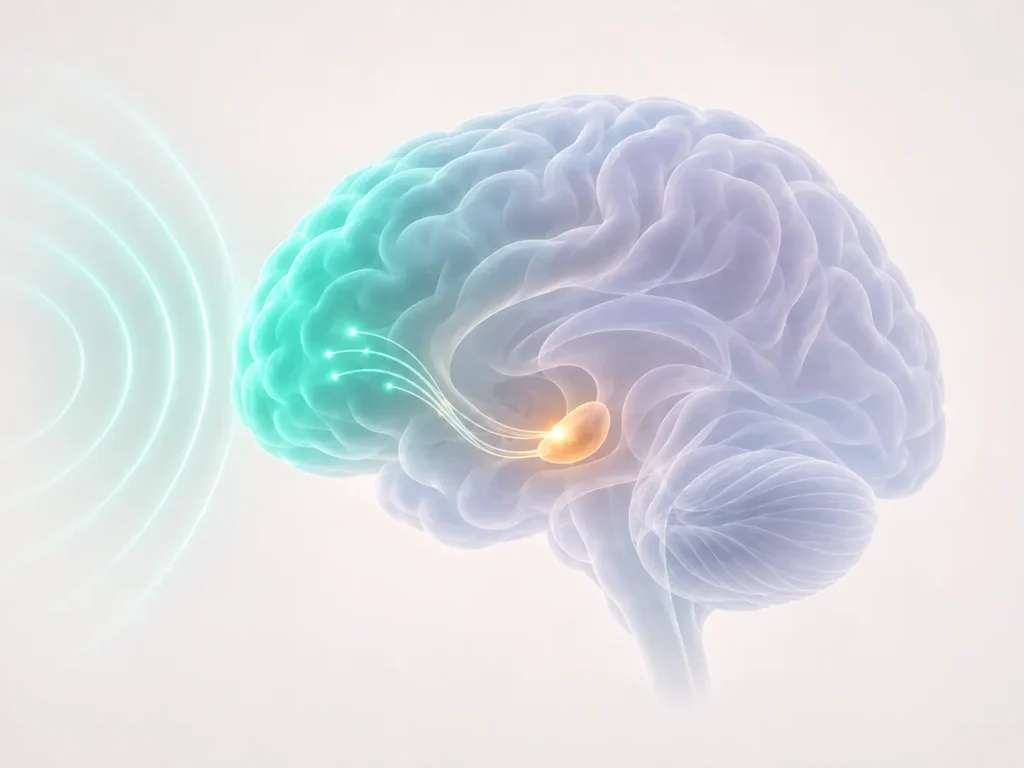
TMS uses focused magnetic pulses to activate nerve cells in brain regions that regulate mood and emotion. A coil resting against the scalp creates a magnetic field that passes painlessly through the skull and generates small electrical currents in the targeted area. Repeated over several weeks, this stimulation helps underactive circuits work more normally.
A helpful comparison is physical therapy for brain networks. A single session changes little, but steady, repeated sessions gradually strengthen communication between regions that have fallen out of sync. For a closer look at the procedure, see this overview of what TMS is and how it works.
The Brain Areas Behind Low Mood and Constant Worry
Both conditions involve the prefrontal cortex, the part of the brain that handles planning, emotional control, and keeping fear responses in check. In depression, activity in the left dorsolateral prefrontal cortex (DLPFC) is often reduced. In anxiety, the brain’s alarm system, including the amygdala, tends to fire too easily while the prefrontal “brakes” don’t engage strongly enough.
These networks are wired together. Stimulating the prefrontal cortex can ripple outward and influence both mood and fear processing, which helps explain why TMS for anxiety and depression often improves both at the same time. This piece on how depression affects the brain and emotional health covers these changes in plain language.
Why Deep TMS Matters for Anxious Depression
Deep TMS (dTMS) uses a specially designed H-coil that reaches deeper and covers a broader area than the figure-8 coil used in traditional TMS. Life Quality TMS uses the BrainsWay Deep TMS system, the platform whose H1 coil received FDA clearance for reducing anxiety symptoms in adults with depression.
| Feature | Traditional TMS (Figure-8 Coil) | Deep TMS (BrainsWay H1 Coil) |
| Coil design | Flat, figure-8 shaped coil | Helmet-style H-coil |
| Stimulation depth | Mostly the outer surface of the cortex | Reaches deeper layers of the prefrontal network |
| Area stimulated | A small, precise spot | A broader region of the prefrontal cortex |
| Effect of high anxiety before treatment | Historically linked to weaker response | Linked to stronger response in clinical data |
What Does Research Say About TMS Therapy for Depression and Anxiety Together?
Research shows that TMS therapy for anxiety and depression can reduce both sets of symptoms within the same treatment course, and that strong anxiety does not have to stand in the way of a good result. Three findings stand out.
FDA Clearance for Anxiety Symptoms in Depression
In 2021, the FDA expanded the BrainsWay Deep TMS clearance to include reducing anxiety symptoms in adults with major depression. The Journal of Clinical Medicine analysis behind that decision pooled data from randomized controlled trials and found a meaningful drop in anxiety scores among depressed patients treated with the H1 coil.
The most surprising result? Patients with higher anxiety at the start actually tended to respond better. That runs opposite to what clinicians usually see with medication, where heavy anxiety often signals a slower or weaker response.
Do Anxiety and Depression Improve Together During TMS?
In most cases, yes. A 2025 retrospective study in Frontiers in Psychiatry followed 86 patients with depression and co-occurring anxiety. Improvements in the two sets of symptoms were closely linked: as depression lifted, anxiety usually eased as well.
The authors also pointed out a gap in earlier research. People with significant anxiety are often excluded from depression trials, even though they make up roughly half of patients seeking depression care. Real-world studies like this help close that gap.
How Researchers Are Fine-Tuning Treatment Targets
Newer studies are testing whether a second brain target can add extra anxiety relief. A clinical trial described by the Brain & Behavior Research Foundation compared two stimulation sites in patients with both conditions. Each relieved depression equally well, but stimulating the dorsomedial prefrontal cortex cut anxiety by 58%, compared with 36% at the standard depression site.
For patients considering TMS therapy for anxiety and depression, the message is practical. Treatment can be adjusted to the symptoms that cause the most disruption, and an experienced TMS team will monitor both mood and anxiety throughout the course.
Who Is a Good Candidate for TMS Treatment for Anxiety and Depression?
TMS treatment for anxiety and depression is usually a strong fit for adults whose depression comes with significant anxiety and hasn’t improved enough with standard care. You may be a candidate if you:
- Have a diagnosis of major depressive disorder along with anxiety symptoms or an anxiety disorder
- Have tried one or more antidepressants without adequate relief
- Struggled with medication side effects such as weight gain, sexual problems, or emotional numbness
- Prefer a non-drug option, or want to add one to your current plan
- Can commit to short daily sessions for several weeks
TMS isn’t right for everyone. Metal implants in or near the head, certain implanted devices, and a history of seizures all require careful screening. A psychiatrist reviews each person’s history before recommending treatment, and the pages on TMS for depression and TMS for anxiety explain eligibility for each condition.

What to Expect From TMS Therapy for Anxiety and Depression
A typical course of TMS therapy for anxiety and depression involves short sessions five days a week for about four to six weeks. You stay awake and alert the entire time, and you can drive yourself home or head straight back to work.
| Stage | What Happens | Typical Timing |
| Consultation | A psychiatrist reviews symptoms, history, and medications; the team handles insurance authorization | One visit, plus approval time |
| Mapping | The team finds the right coil position and stimulation strength | First treatment day |
| Daily sessions | Treatment in a comfortable chair while you read, listen, or relax | About 20 minutes, 5 days a week |
| Early changes | Many people notice better sleep, more energy, or less tension | Around weeks 2 to 4 |
| Completion | Progress is reviewed, and a maintenance plan is discussed if needed | Weeks 4 to 6 |
Side effects are usually mild. The most common are scalp discomfort or headaches during the first week, and they typically fade as treatment continues. Serious side effects such as seizures are very rare.
Simple Ways to Get the Most From Each Session
- Keep a consistent schedule. Missed sessions can slow progress, so choose a time slot that fits your routine.
- Track your symptoms. A short daily note on mood, worry, and sleep reveals trends that are easy to miss.
- Continue talk therapy if you have it. Many patients find therapy easier to engage with as symptoms ease.
- Avoid changing medications on your own. Any adjustment should go through your psychiatrist.
- Expect uneven progress. Anxiety and depression don’t always improve at the same pace, and a harder week after a good one is normal.
Start TMS for Anxiety and Depression in Downtown Brooklyn
Living with both conditions can feel like fighting on two fronts, but TMS therapy for anxiety and depression offers a way to address both at once without adding another medication.
Life Quality TMS provides Deep TMS at 26 Court Street, Suite 1510, close to multiple subway lines and convenient for patients from Brooklyn Heights, DUMBO, Fort Greene, Boerum Hill, Cobble Hill, Manhattan, and Queens.
Schedule a consultation or call (718) 400-0867 to find out whether TMS is right for you.
Frequently Asked Questions
Yes. BrainsWay Deep TMS is FDA-cleared to treat depression and reduce co-occurring anxiety symptoms within the same course, and both usually improve together.
Many people notice early changes within two to four weeks, often in sleep, energy, or physical tension. Full benefits build over the complete course.
FDA clearance currently covers anxiety symptoms that occur alongside depression. Psychiatrists sometimes use TMS off-label for generalized anxiety disorder after an evaluation.
Yes, most patients continue their current prescriptions. Any changes should be gradual and supervised by a psychiatrist.
Most people describe a tapping sensation on the scalp. Mild headaches can occur early on and usually fade within the first week or two.
Most major plans, including Medicare, cover TMS for depression when certain criteria are met. The clinic verifies benefits and handles prior authorization.