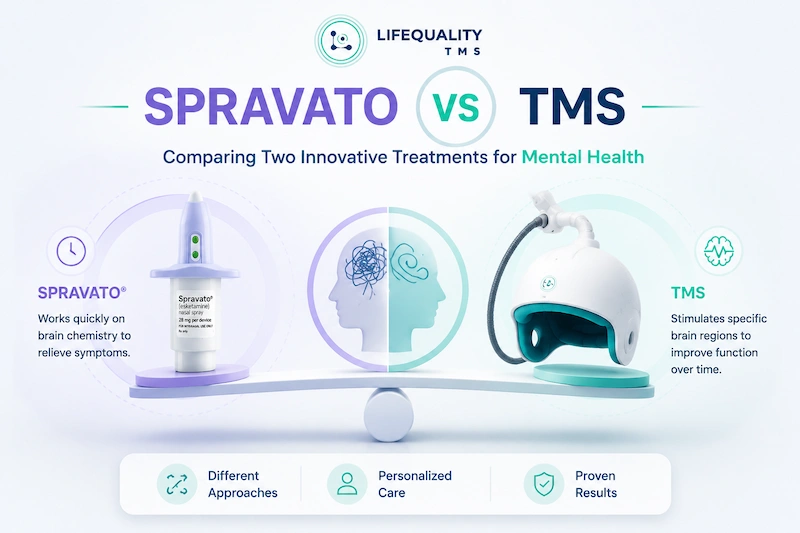
According to a 2025 individual participant data analysis published in eClinicalMedicine (The Lancet), intranasal esketamine does not appear to be more effective than TMS for treatment-resistant depression; TMS was found to be similarly effective, or potentially even superior, to Spravato across key outcomes.
That is a striking finding, especially for patients who assume a medication-based treatment is inherently more powerful than a non-drug one. Spravato vs TMS is a question more people are asking as both treatments become more widely available. They share one important characteristic: both are designed for patients whose depression has not responded adequately to standard antidepressants. Beyond that, they are very different experiences.
Here is what you need to know to have an informed conversation with your provider.
Spravato vs TMS at a Glance
| Factor | TMS | Spravato |
| What it is | Magnetic stimulation of brain circuits | Esketamine nasal spray (derived from ketamine) |
| How it’s given | Outpatient sessions, no drugs involved | Nasal spray in a certified clinic, with oral antidepressant |
| FDA status | Cleared for MDD, OCD, anxious depression, smoking cessation | Approved for treatment-resistant depression and MDD with suicidal ideation |
| Speed of relief | Weeks 2-4 of treatment | Hours to days after first dose |
| Duration of benefit | 6-12+ months for most responders | Ongoing dosing required to maintain effect |
| Side effects | Mild scalp discomfort, headache; no systemic effects | Dissociation, dizziness, nausea, blood pressure changes |
| Can you drive after? | Yes, immediately | No: 2-hour monitored observation required |
| Insurance coverage | Broadly covered for qualifying diagnoses | Covered for FDA-approved indications; requires prior authorization |
| Drug involvement | None | Yes: esketamine plus a required oral antidepressant |
How Does Each Treatment Work?
TMS: Stimulating the Brain Without Medication
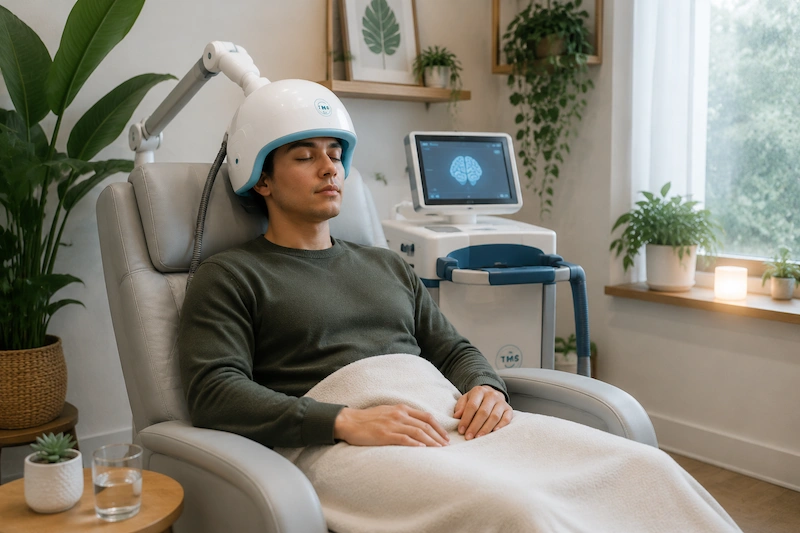
TMS uses a magnetic coil placed gently against the scalp to deliver focused pulses to the prefrontal cortex, the area most consistently underactive in depression. Over 20 to 30 sessions, those pulses promote neuroplasticity, encouraging the brain to build stronger, healthier neural connections.
Key things patients notice about the TMS experience:
- No drugs enter your body at any point
- You remain fully awake and alert throughout each session
- Sessions are 20 to 40 minutes; you can drive yourself home and return to work immediately
- Side effects, primarily mild scalp tingling or headache, are limited to the first week for most patients
- The course is front-loaded: four to six weeks of daily sessions, then no maintenance required for most patients
Spravato: Fast-Acting Relief Through Esketamine
Spravato is the brand name for esketamine, a nasal spray derived from ketamine and FDA-approved in 2019 for treatment-resistant depression and major depression with suicidal ideation. It must be taken alongside an oral antidepressant; it is not a standalone treatment.
Spravato works by blocking NMDA receptors in the brain, rapidly increasing glutamate activity and triggering neuroplasticity within hours. For patients in severe distress, that speed is its most important clinical advantage.
What the Spravato experience involves:
- Administered in a certified clinical setting under medical supervision
- A two-hour observation period is required after each dose before you can leave
- You cannot drive on the day of treatment: arrange transportation in advance
- Sessions are twice weekly for four weeks, then weekly, then every one to two weeks
- Dissociation (a temporary feeling of detachment) occurs in many patients during the session and resolves within the observation window
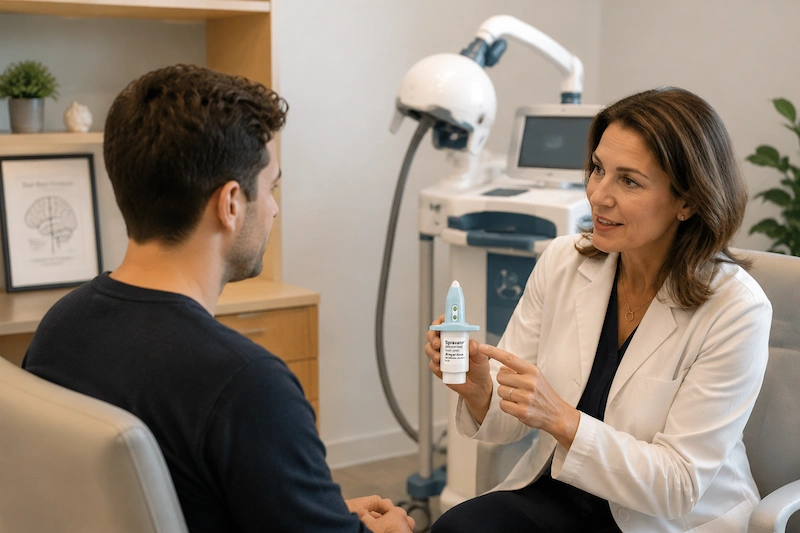
Is Spravato or TMS More Effective?
What Head-to-Head Research Shows
The most rigorous head-to-head data comes from a 2026 propensity-matched comparison of two randomized clinical trials (THREE-D and TRANSFORM-2), cited in a J&J Medical Connect clinical analysis. It found no statistically significant difference in depression score improvement between TMS and Spravato at four weeks. A separate multicenter observational study of 59 treatment-resistant patients found that accelerated TMS achieved higher response rates than Spravato at one month, though remission rates between the two groups were comparable at three months.
Neither treatment consistently outperforms the other. Where they differ is in how quickly they work, how long results last, and what the treatment experience involves.
Where Each Has an Edge
TMS pulls ahead on:
- Durability: Most TMS responders maintain improvement for 6 to 12 months or longer without continuous dosing
- Side effect profile: No sedation, no dissociation, no systemic effects, no required escort home
- Independence from medication: TMS works without requiring a concurrent antidepressant
Spravato pulls ahead on:
- Speed: Relief can begin within hours of the first dose, making it valuable for acute or crisis presentations
- Acute suicidality: Spravato is specifically FDA-approved for major depression with active suicidal ideation, a clinical scenario where TMS would not typically be the first choice
- No daily commitment: Spravato sessions follow a tapering schedule; a TMS course requires five appointments per week for four to six weeks
Can You Do TMS and Spravato at the Same Time?
The Case for Combining Them
TMS and Spravato together is an approach that makes intuitive clinical sense: Spravato provides fast early relief while TMS builds durable neuroplasticity changes. The two treatments target different neural pathways and are not pharmacologically contraindicated with each other.
Clinics offering both treatments increasingly describe a sequential or overlapping model: Spravato to stabilize acute symptoms, with TMS running concurrently or beginning shortly after. A January 2025 clinical review published by Crownview Psychiatric Institute notes that combining TMS or Spravato with psychotherapy improves outcomes beyond either treatment alone, suggesting integrated care is the direction the field is heading.
What to Know Before Combining
The answer involves a few logistical realities:
- Transportation planning: You cannot drive on Spravato days; TMS days carry no such restriction. Scheduling both in the same week requires coordinating rides on Spravato treatment days.
- Cost and coverage: Running both treatments simultaneously increases out-of-pocket exposure if either requires prior authorization or is partially covered. Confirm coverage for each separately before starting.
- Provider coordination: Both treatments should be overseen by a psychiatrist who knows your full picture, not managed in isolation at separate clinics.
- No strong RCT evidence yet for simultaneous use: Clinically, the combination is reasonable, but large randomized trials specifically studying TMS and Spravato together are still underway. Your provider’s judgment about sequencing matters.
TMS vs Spravato: Choosing The Right Treatment
TMS and Spravato are clinical equals in effectiveness for treatment-resistant depression, according to the most rigorous head-to-head data available. The right choice comes down to your specific situation: how urgently you need relief, whether you can commit to a daily schedule, your transportation options, and what your insurance covers.
If you are in Brooklyn or greater New York City and want to explore whether TMS, Spravato, or a combination approach is right for you, contact LifeQuality TMS to schedule a psychiatric consultation. We serve patients from Brooklyn Heights, DUMBO, Fort Greene, Boerum Hill, and Cobble Hill, with easy access from Manhattan and Queens.
Frequently Asked Questions
What is the main difference between Spravato and TMS?
Spravato is an esketamine nasal spray that produces fast relief by blocking NMDA receptors in the brain; it requires clinical supervision, a two-hour observation period after each dose, and a concurrent oral antidepressant. TMS uses magnetic pulses to stimulate brain circuits non-invasively, with no drugs involved, no downtime, and no escort needed after sessions. Both are FDA-approved or FDA-cleared for treatment-resistant depression, with comparable overall effectiveness.
Is Spravato or TMS more effective for depression?
Current head-to-head data shows no consistent superiority of one over the other in overall effectiveness. TMS tends to produce more durable results, with many patients maintaining improvement for six to twelve months or longer. Spravato works faster, often within hours, making it more appropriate for acute situations. For long-term relief without ongoing dosing, TMS has an advantage; for rapid stabilization, Spravato does.
Can I do TMS and Spravato at the same time?
Yes, the two treatments are not contraindicated together and target different neural pathways. Clinically, combining them can offer fast early relief from Spravato while TMS builds longer-lasting neuroplasticity changes. Practically, it requires planning for transportation on Spravato days, confirming insurance coverage for both, and having a psychiatrist coordinate both treatments as a unified plan.
Does Spravato require me to stop taking my antidepressant?
No. Spravato is specifically approved as an add-on to an oral antidepressant, not as a replacement. It must be taken alongside a current antidepressant medication as part of its FDA-approved protocol.
How long does Spravato treatment last compared to TMS?
A standard TMS course runs four to six weeks of daily sessions; most responders do not need continuous treatment afterward. Spravato follows a tapering schedule: twice weekly for four weeks, then weekly, then every one to two weeks indefinitely for patients who respond. TMS has a more defined endpoint; Spravato typically requires ongoing maintenance dosing to sustain results.
Is Spravato covered by insurance?
Spravato is FDA-approved and covered by many major insurance plans for its approved indications, specifically treatment-resistant depression and major depression with active suicidal ideation. Coverage requires prior authorization and documentation of failed antidepressant trials. TMS is similarly covered for qualifying depression diagnoses. Confirming both with your insurer before beginning is an important first step your treatment provider can assist with.