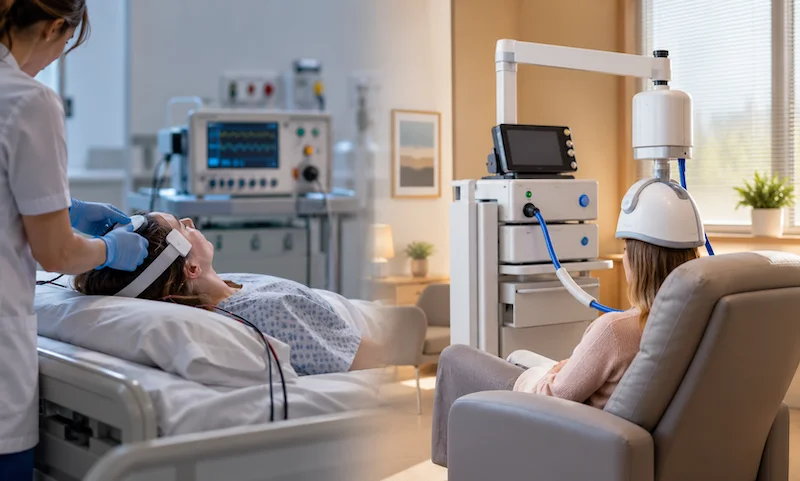
When medication alone is not enough to manage bipolar disorder, particularly its depressive phases, two non-pharmacological treatments come up most often in clinical conversations: electroconvulsive therapy (ECT) and transcranial magnetic stimulation (TMS). Both target brain activity directly. Both have meaningful clinical evidence behind them. And both are used for bipolar treatment in different clinical contexts. But they differ significantly in how they work, what they feel like, who they are appropriate for, and what side effects patients should expect.
This article compares ECT vs TMS for bipolar disorder honestly, covering the clinical evidence, practical differences, and safety profiles of each, so that patients and their families can have more informed conversations with their treatment teams.
What Is ECT and How Does It Work?
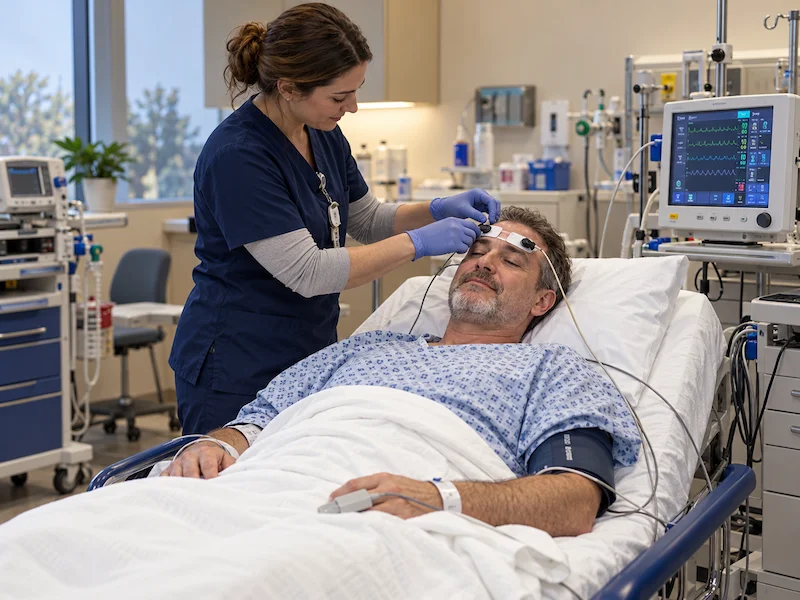
Electroconvulsive therapy (ECT) is one of the oldest and most effective treatments for severe psychiatric disorders, including severe bipolar depression, mania, and catatonia. During an ECT session, a brief electrical current is applied to the scalp while the patient is under general anesthesia, deliberately inducing a controlled therapeutic seizure lasting approximately 30 to 60 seconds. The mechanism by which this produces antidepressant effects is not fully understood, but it is thought to involve a broad reset of dysregulated neural circuits involved in mood.
ECT is administered two to three times per week over two to six weeks. Because it requires general anesthesia and muscle relaxants, each session involves significant preparation and a recovery period. Most patients need a hospital or surgical center setting rather than an outpatient clinic. They cannot drive on the day of treatment, and someone must accompany them to each appointment.
ECT bipolar treatment is primarily considered for the most severe presentations: acute suicidality requiring rapid intervention, bipolar depression with psychotic features, severe manic or mixed states, or patients who have failed multiple medication regimens and cannot wait weeks for a response.
What Is TMS and How Does It Work?
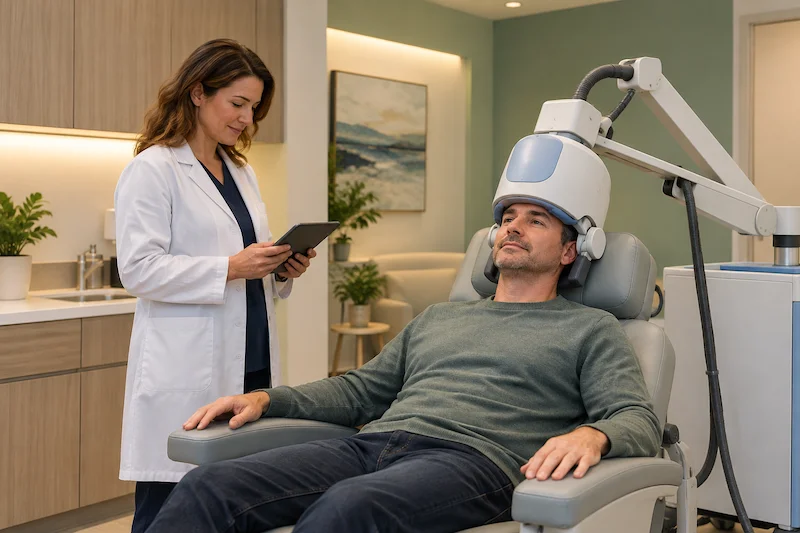
TMS for bipolar treatment takes an entirely different approach. Rather than inducing a seizure, TMS delivers focused magnetic pulses to a specific brain region (most commonly the left dorsolateral prefrontal cortex) to modulate neural activity in the circuits associated with mood regulation. The patient remains fully awake, seated in a reclining chair, with a magnetic coil positioned against the scalp. No anesthesia, no sedation, no recovery time.
A standard TMS therapy for bipolar disorder treatment course involves daily sessions five days per week over four to six weeks. Sessions using BrainsWay Deep TMS – the system used at LifeQuality TMS – take approximately 20 minutes. Patients can drive themselves to and from appointments and return to work, errands, or other daily activities immediately afterward.
TMS is FDA-cleared for major depressive disorder and OCD. Its use in bipolar depression is currently an off-label application, though the FDA granted breakthrough device status for TMS in bipolar depression in 2020, reflecting the strength of the emerging evidence base and the unmet clinical need.
ECT vs TMS for Bipolar: Side-by-Side Comparison
| Feature | ECT | TMS |
| Mechanism | Electrical current induces controlled seizure | Magnetic pulses stimulate specific brain circuits |
| Anesthesia required | Yes, general anesthesia every session | No |
| Setting | Hospital or surgical center | Outpatient clinic |
| Session length | 2-3 hours including prep and recovery | 20-40 minutes |
| Sessions per week | 2-3 | 5 |
| Recovery after session | 30+ min monitoring; cannot drive that day | None; can drive immediately |
| Speed of response | Often rapid, within days to weeks | Gradual, typically weeks 2-6 |
| FDA status for bipolar | Established clinical use (off-label for depression, labeled for some uses) | Off-label; FDA breakthrough device status 2020 |
| Memory side effects | Reported by 29-84% of patients | Rare; not a documented concern |
| Common mild side effects | Memory loss, confusion, headache, muscle aches | Scalp discomfort, mild headache, transient |
| Availability | Hospital psychiatric units | Outpatient TMS clinics |
| Insurance coverage | Generally covered for severe cases | Variable for bipolar; broader for MDD |
Effectiveness: What Does the Evidence Show?
ECT for Bipolar Depression and Mania
ECT has one of the longest clinical track records in psychiatry. A 2017 study involving 522 participants with drug-resistant bipolar disorder found ECT effective across depressive, manic, mixed, and catatonic presentations, with better outcomes in patients with shorter and less severe episodes. For urgent situations like severe suicidality, psychotic features, acute mania refractory to medication, ECT can produce meaningful improvement faster than almost any other available treatment.
A systematic review comparing ECT directly with high-frequency TMS found that ECT achieved a response rate of 64.4% and a remission rate of 53%, compared to response and remission rates of 48.7% and 32.2% for high-frequency rTMS, respectively. This confirms what clinicians generally observe: ECT has a stronger short-term antidepressant effect, particularly in the most severe cases.
TMS for Bipolar Depression
The evidence base for TMS therapy for bipolar disorder treatment has expanded considerably in recent years. A comprehensive meta-analysis synthesizing data from 56 studies found that active TMS demonstrated superior antidepressant efficacy compared to sham stimulation, with response and remission rates on par with those seen in unipolar depression – approximately 47% and 28%, respectively. Rates of treatment-emergent mania or hypomania were low and equivalent to those in sham-treated patients.
A 2025 open-label multicenter study of accelerated TMS specifically in bipolar II patients found rapid onset of antidepressant effects with no significant increase in mania ratings and no reported hypomanic switches. For patients in the depressive phase of bipolar disorder who do not require emergency intervention, TMS offers a meaningful, well-tolerated treatment path.
The honest summary: ECT shows stronger short-term efficacy, particularly for severe or acute presentations. TMS shows comparable response rates to those seen in MDD, with a significantly more favorable tolerability profile and a far lower burden of side effects.
Safety and Side Effects: The Critical Difference
This is where ECT and TMS diverge most meaningfully for most bipolar patients.
ECT Side Effects
The most clinically significant and widely discussed concern with ECT bipolar treatment is cognitive impairment, particularly memory loss. A systematic review found that between 29% and 55% of ECT patients reported experiencing long-lasting or permanent memory changes. A more recent international patient survey reported memory loss across four different measures in 61 to 84% of ECT patients, with more than half reporting that memory loss lasted longer than three years.
The memory effects of ECT are not uniform. Anterograde memory – the ability to form new memories – tends to recover after treatment ends. Retrograde memory – recall of events before treatment – is more variable and more likely to be persistently affected, particularly for autobiographical memories around the time of treatment. Modern ECT techniques, including brief-pulse and ultra-brief-pulse stimulation, have reduced but not eliminated these cognitive effects.
ECT also carries the risks associated with general anesthesia, which is required for every session. While anesthetic risks are low in healthy adults, they are a relevant consideration for patients with cardiovascular conditions or other comorbidities.
TMS Side Effects
TMS therapy for bipolar disorder treatment has a substantially more favorable side effect profile. The most commonly reported effects are mild scalp discomfort and headache during or shortly after sessions, both of which typically resolve within the first one to two weeks of treatment. No anesthesia is required, so there are no anesthesia-related risks. Memory impairment is not a documented concern with TMS. The seizure risk is very low – estimated at less than 1 in 10,000 sessions, and is primarily relevant for patients with pre-existing seizure history or those on medications that lower the seizure threshold.
For a patient with bipolar disorder who already faces cognitive vulnerabilities associated with the illness itself, the absence of cognitive side effects with TMS is a clinically meaningful advantage.
When Might ECT Be Considered Over TMS?
ECT remains an important tool in psychiatry, and there are specific situations where it may be the more appropriate choice:
- Acute suicidality requiring rapid response: ECT can produce meaningful improvement within days. TMS works more gradually.
- Bipolar depression with psychotic features: ECT has a longer track record in psychotic presentations. TMS evidence in this subgroup is limited.
- Severe manic or catatonic states: ECT treatment for bipolar disorder is one of the few non-pharmacological options effective for acute mania and catatonia. TMS is not used for these presentations.
- Failure to respond to TMS: For patients who complete a full TMS course without adequate response, ECT may be the appropriate next step.
Who Is a Good Candidate for TMS for Bipolar Treatment?
TMS for bipolar treatment is most appropriate when:
- The current episode is primarily depressive, not manic, mixed, or catatonic
- There is no immediate crisis requiring emergency intervention
- The patient is stabilized on at least one mood stabilizer
- Standard pharmacological treatments for bipolar depression have provided insufficient relief
- The patient’s schedule allows for daily outpatient sessions
- Minimizing cognitive side effects is a priority
For patients in this category, TMS therapy for bipolar disorder treatment offers a well-tolerated, outpatient, medication-free approach with a growing and encouraging evidence base. At LifeQuality TMS in Brooklyn, all bipolar patients are evaluated by a licensed psychiatrist before treatment begins, with mood stabilization confirmed and a monitoring plan established before the first session.
For an overview of the protocols used in treatment, see our TMS protocols overview.
Frequently Asked Questions: ECT vs TMS for Bipolar
1. Is ECT or TMS more effective for bipolar disorder?
ECT generally shows stronger short-term antidepressant effects, particularly in severe or treatment-resistant cases, with response rates around 64% compared to approximately 47% for high-frequency TMS in direct comparison studies. However, TMS offers comparable outcomes to what is seen in unipolar depression treatment, with a significantly better side effect profile. For non-urgent bipolar depression, TMS is often the preferred first-line neuromodulation option precisely because of its tolerability.
2. Does TMS cause memory loss like ECT does?
No. Memory impairment is not a documented side effect of TMS. This contrasts meaningfully with ECT, where memory loss – both short-term and, in some cases, longer-term – is one of the most commonly reported concerns. For bipolar patients who already experience cognitive effects from the illness or from long-term medication use, this distinction is clinically significant.
3. Can TMS treat mania as well as depression in bipolar disorder?
No. TMS is used specifically to target the depressive pole of bipolar disorder. It is not a treatment for acute mania, hypomania, or catatonia. ECT has broader applications across bipolar presentations including mania and catatonia, which is one reason it remains an important option for the most severe cases.
4. Is TMS for bipolar treatment covered by insurance?
TMS for bipolar depression is an off-label use, which means coverage is more variable than for FDA-cleared indications like MDD. Some insurers approve TMS for bipolar depression with appropriate documentation of diagnosis, treatment history, and medical necessity. LifeQuality TMS handles all prior authorization submissions on behalf of patients and can advise on what your specific plan requires.
5. Do I need general anesthesia for TMS?
No. TMS requires no anesthesia, no sedation, and no recovery time. You remain fully awake during the session and can drive yourself to and from appointments. This is one of the most significant practical advantages of TMS over ECT, which requires general anesthesia for every session.
6. Can I switch from ECT to TMS?
Yes, in principle. Some patients who have completed ECT courses and achieved stabilization later pursue TMS for ongoing or recurrent depressive episodes, particularly when they want to avoid the cognitive side effects associated with continued ECT. The transition requires a full psychiatric evaluation and review of your current mood stabilization. Discuss this with your treating psychiatrist to determine whether it is appropriate in your situation.
7. Does LifeQuality TMS offer ECT?
No. LifeQuality TMS specializes in BrainsWay Deep TMS – an FDA-cleared, outpatient, non-invasive treatment for depression and OCD. If your clinical situation requires ECT, your psychiatrist can provide an appropriate referral. For patients whose bipolar depression is being treated in the depressive phase and who are stabilized on a mood stabilizer, TMS may be an effective and better-tolerated alternative worth discussing.
If you are weighing treatment options for bipolar depression and want to understand whether TMS is a fit for your situation, the team at LifeQuality TMS in Downtown Brooklyn is here to help. Schedule a consultation, and we will review your history and goals together. We serve patients from Brooklyn Heights, DUMBO, Fort Greene, Cobble Hill, Manhattan, Queens, and across New York City.