The following article explores the emerging role of neuromodulation in the fight against neurodegenerative decline. By examining the current evidence and clinical research, we aim to provide a clear perspective on how TMS therapy for dementia and Alzheimer’s is being utilized to support cognitive health and offer new hope for those in the early stages of the disease.
Dementia is not a single disease but rather an umbrella term that describes a collection of symptoms related to cognitive decline. While many conditions fall under this category—including vascular dementia and Lewy body dementia—Alzheimer’s disease is the most prevalent, accounting for the vast majority of cases.
It is characterized by the gradual accumulation of proteins in the brain that disrupt communication between neurons, eventually leading to memory loss and personality changes. For years, the medical community has sought a way to stop this progression, and recently, the focus has shifted toward the potential of magnetic stimulation to bridge the gap where traditional medicine often falls short.
Can TMS Therapy Help with Dementia and Alzheimer’s?
The question of whether we can physically stimulate the brain back into a state of higher function is at the heart of modern neuroscience. While TMS has long been an established treatment for depression, its application in the field of memory disorders is a newer, yet rapidly expanding, frontier.
Research and Clinical Trials
As of 2026, the volume of research into TMS therapy for dementia and Alzheimer’s has grown significantly. Large-scale clinical trials have moved beyond simple safety tests to investigate specific “hubs” in the brain, such as the precuneus and the dorsolateral prefrontal cortex (DLPFC).
These studies often compare active magnetic stimulation against a “sham” or placebo treatment to measure real-world improvements in memory and executive function. The data suggests that when the right areas are targeted with precision, the brain’s neural networks can show signs of renewed activity that medication alone has not been able to produce.
Early-Stage Treatment Potential
The most promising results for TMS therapy for dementia and Alzheimer’s appear to be in the “prodromal” or early stages of the disease. This is the window where the brain still possesses enough plasticity to respond to external stimulation.
By intervening early, clinicians hope to strengthen the existing neural connections before the damage becomes too widespread. It is much easier to maintain a bridge that is beginning to fray than it is to rebuild one that has already collapsed, making early diagnosis and prompt treatment initiation a priority for patients looking into this technology.
What Does TMS Therapy Do for Dementia and Alzheimer’s?
The mechanism behind TMS is fascinating because it doesn’t rely on chemical intervention. Instead, it uses electromagnetic induction to create a small electrical current in the brain tissue. This process has several cascading effects on how a person thinks and feels.
Cognitive Improvements
The primary goal of TMS therapy for dementia and Alzheimer’s is to stabilize or improve cognitive function. Patients and caregivers often report better “word-finding” abilities, improved focus on daily tasks, and a more consistent memory of recent events. While it is not a cure, the ability to maintain one’s independence for several additional months or years is an invaluable outcome for families.
Enhancing Brain Function and Neuroplasticity
Dementia often causes a “quieting” of certain brain regions. TMS therapy for dementia and Alzheimer’s works by increasing cortical excitability—essentially “waking up” these dormant areas. Furthermore, the repetitive nature of the pulses encourages neuroplasticity, which is the brain’s ability to form new synaptic connections. By repeatedly firing these circuits, TMS helps the brain find new pathways to process information, bypassing some of the damaged sections.
Emotional and Behavioral Benefits
One of the most difficult aspects of memory loss is the accompanying frustration, anxiety, and depression. Because the areas of the brain that control memory are closely linked to those that regulate mood, TMS therapy for dementia and Alzheimer’s often has the side effect of stabilizing emotions. Reducing the “behavioral” symptoms of dementia, such as agitation or apathy, can significantly improve the quality of life for both the patient and their caregivers.
Does TMS Help with Dementia? Understanding the Evidence
It is natural for families to be skeptical of new treatments, especially in a field where so many “breakthroughs” have failed to deliver. However, the evidence for TMS and dementia is building on a foundation of solid, peer-reviewed data.
Studies Supporting TMS for Dementia
Meta-analyses of dozens of controlled trials show a consistent trend: patients receiving high-frequency TMS therapy for dementia and Alzheimer’s perform better on standardized cognitive tests, such as the MMSE (Mini-Mental State Examination), compared to those who do not.
These studies highlight that the benefits are not just a “placebo effect” but a measurable change in how the brain processes data. Does TMS help with dementia? The current consensus is that while it varies by individual, the statistical evidence points to a clear therapeutic benefit.
TMS vs. Traditional Treatments
Standard Alzheimer’s medications, like cholinesterase inhibitors, work by increasing the levels of certain chemicals in the brain. While helpful, they often come with gastrointestinal side effects, and their efficacy tends to wane over time.
TMS therapy for dementia and Alzheimer’s offers a non-systemic alternative. It doesn’t circulate through the bloodstream, meaning there are no “tummy troubles” or drug interactions to worry about. For many, it serves as a powerful “add-on” therapy that works alongside existing medications to provide a multi-pronged approach to care.
Does TMS Help with Alzheimer’s Disease?
Specifically for Alzheimer’s, researchers are finding that TMS may help clear or reduce the impact of amyloid plaques by improving the brain’s “waste disposal” systems and reducing inflammation.
By enhancing the health of the neurons, TMS makes the brain more resilient to the proteins that characterize the disease. So, when people ask, “Does TMS help with Alzheimer’s disease?” the answer increasingly looks like a “yes,” provided the treatment is consistent and part of a broader health plan.

What to Expect During and After TMS Therapy for Dementia
For many seniors, the idea of “brain stimulation” can sound intimidating. However, the actual process of TMS therapy for dementia and Alzheimer’s is surprisingly mundane and non-invasive.
The TMS Treatment Process
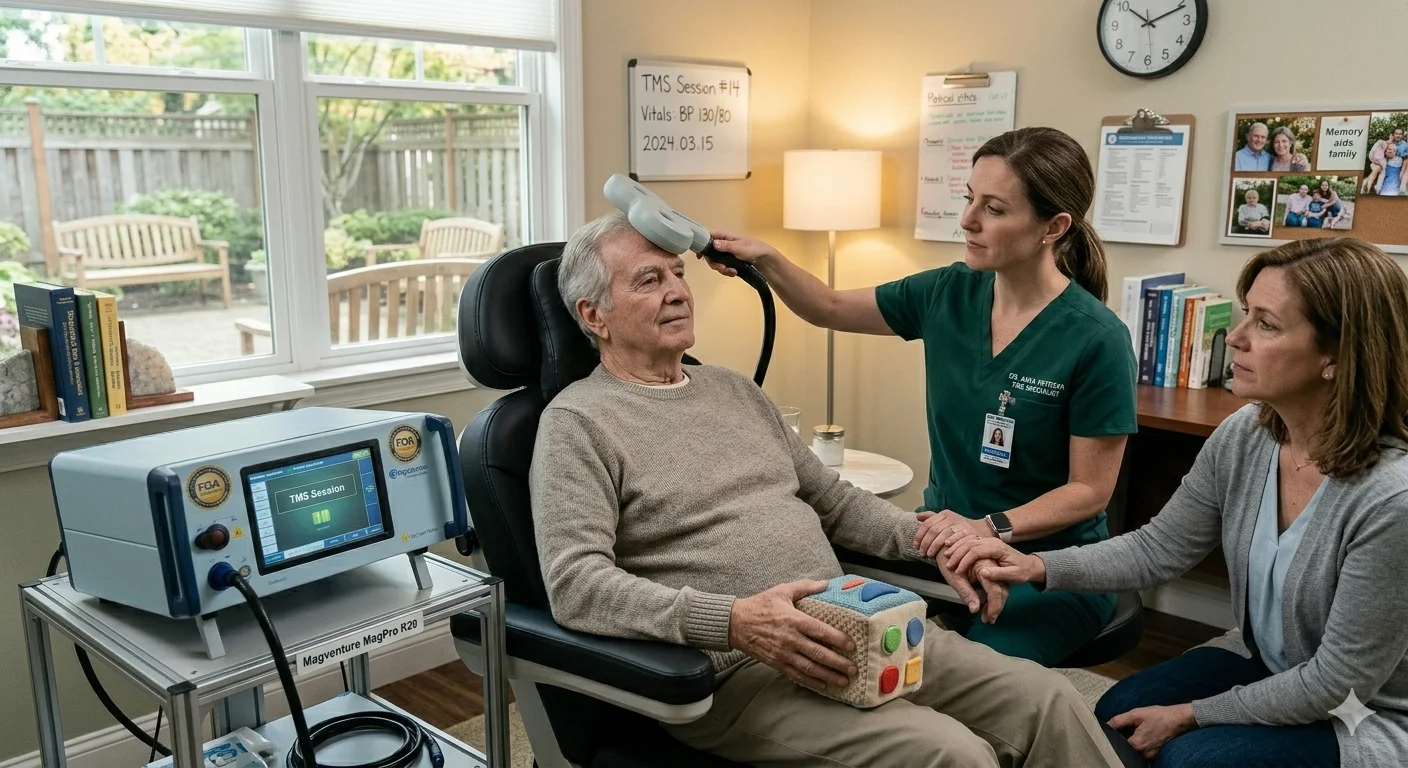
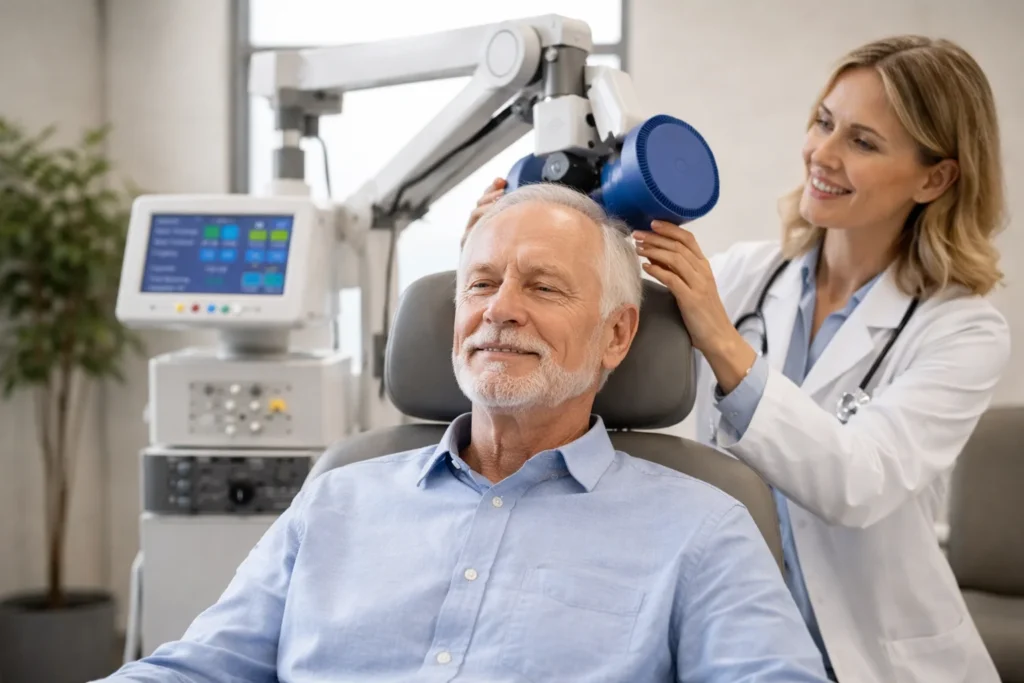
A typical course involves the patient sitting in a comfortable, reclining chair. A small magnetic coil is placed against the head, near the temple or the crown. During the session, the patient will hear a clicking sound—much like a woodpecker tapping—and feel a light tapping sensation on the scalp. There is no anesthesia, no needles, and the patient is fully awake, often chatting with the technician or watching a show. Sessions usually last about 20 to 30 minutes, making it a manageable part of a daily routine.
Side Effects and How to Manage Them
The safety profile of TMS therapy for dementia and Alzheimer’s is excellent. The most common side effect is a mild headache or some scalp tenderness at the site of the stimulation. These are usually temporary and can be managed with over-the-counter pain relief or by simply adjusting the position of the coil. Unlike surgery or intensive drug regimens, there is no “recovery time” required after a session; patients can go straight from the clinic to lunch or a walk in the park.
Monitoring Progress and Adjustments
Because every person’s brain is unique, the best TMS therapy for dementia and Alzheimer’s providers will perform regular cognitive “check-ins.” They use memory tests and mood scales to see how the patient is responding and will adjust the frequency or location of the magnetic pulses accordingly. This personalized approach ensures that the stimulation is always hitting the areas that need the most help.
Conclusion: A New Horizon for Cognitive Care
The shift toward using TMS therapy for dementia and Alzheimer’s represents a more proactive, hopeful era in geriatric medicine. For too long, a diagnosis of cognitive decline felt like a one-way street with no turn-offs. Today, we are learning that the brain is far more resilient than we once believed and that with the right kind of physical encouragement, we can preserve the qualities that make us who we are for a longer period.
By focusing on cognitive improvements, enhancing neuroplasticity, and offering a safe alternative to traditional treatments, TMS therapy for dementia and Alzheimer’s is carving out a vital role in modern care. It offers a way to fight back against the symptoms of the disease while respecting the comfort and dignity of the patient. While we wait for a definitive cure, these magnetic pulses are providing something just as important: more time, more clarity, and a better quality of life for families navigating the challenges of memory loss.