Depression and anxiety together represent the leading causes of disability worldwide. Major depressive disorder alone affects an estimated 280 million people globally, and the gap between those who need care and those who receive effective treatment remains staggering. What makes this more frustrating is that for many, the treatments that exist simply don’t work well enough.
This is precisely why the expansion of new depression treatment options over the past decade represents such a significant shift in mental health care — not as hype, but as a genuine clinical need being answered.
Why New Treatments for Depression Are Needed
Traditional approaches were built on a neurochemical model of depression that is increasingly understood to be incomplete. Depression is not simply a serotonin deficiency; it involves disrupted neural circuits, impaired neuroplasticity, inflammatory processes, and structural brain changes that antidepressants alone don’t address. New treatments are targeting these mechanisms directly — with results that are changing what remission looks like for people who had run out of options.
The most important development is speed. Most antidepressants require four to six weeks to produce measurable effects — a timeline that is clinically dangerous in severe or actively suicidal presentations. Several new depression treatments work within hours to days. That compression of response time is not a minor convenience; it is a paradigm shift in acute care.
Brain Stimulation Therapies Leading the Shift
TMS Therapy (Transcranial Magnetic Stimulation)
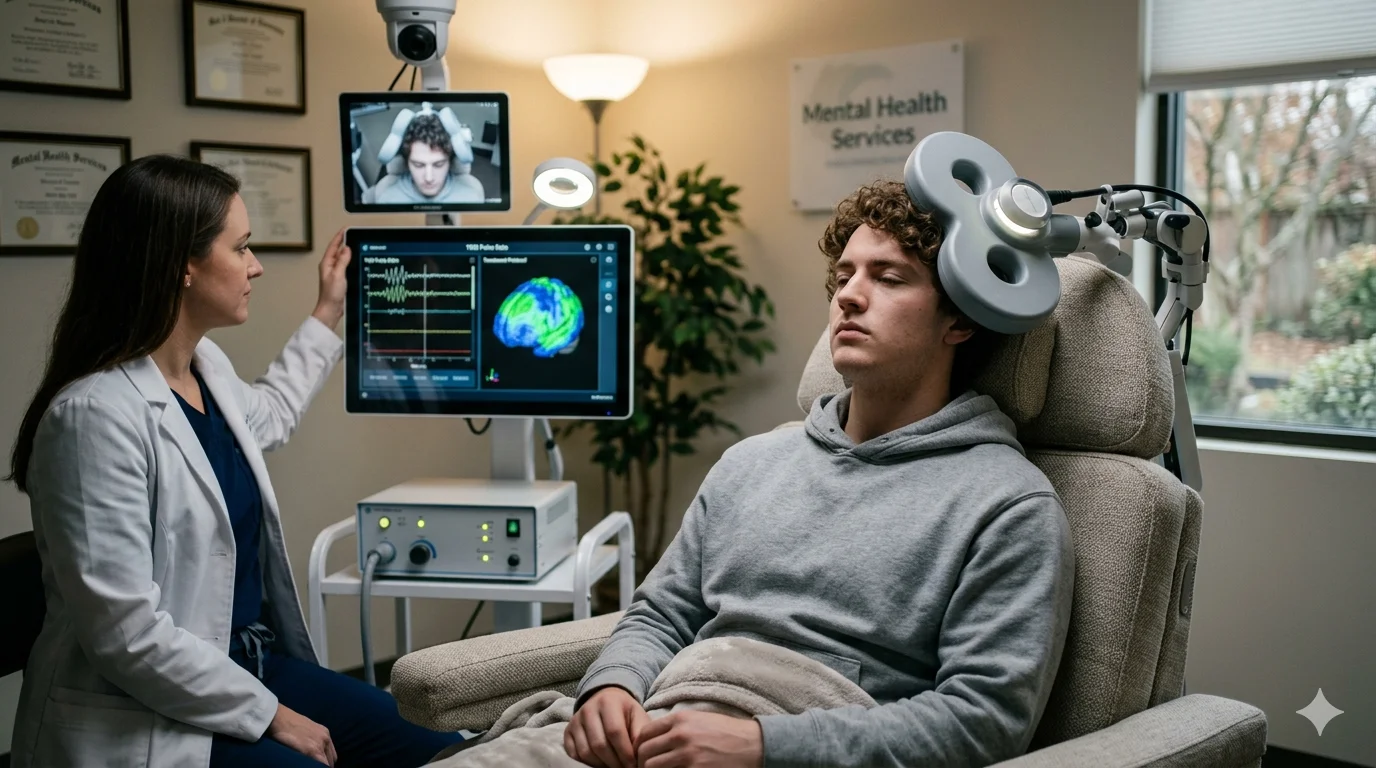
TMS is the most accessible and widely adopted of the new treatments for depression. It uses focused magnetic pulses to stimulate the dorsolateral prefrontal cortex — a brain region consistently underactive in depression — without medication, anesthesia, or hospitalization. Sessions run 20–40 minutes and are delivered in outpatient settings over a course of several weeks.
The evidence base is substantial and growing. A 2024 PMC systematic review of TMS and ketamine combination therapy confirms that TMS produces significant reductions in depression severity for treatment-resistant patients, with adverse effects that are generally mild and transient. In real-world practice, up to 83% of patients show measurable improvement, and more than half achieve full remission.
What distinguishes TMS from older approaches is its precision. Rather than altering the neurochemistry system-wide through pharmacology, it modulates the specific circuits disrupted in depression, reducing overactivity in rumination networks while stimulating underactive motivation and executive function regions. For patients whose depression hasn’t responded to medication, this mechanism offers a fundamentally different path to relief.
LifeQuality TMS in Brooklyn uses the BrainsWay deep TMS device, which penetrates deeper cortical structures than traditional coils. Learn more about how TMS treatment works before your first consultation, and explore how TMS for depression at LifeQuality TMS is delivered in practice.
Electroconvulsive Therapy (ECT) — Modern Approach
ECT has a troubled historical reputation, but the modern version is a markedly different procedure from what was practiced decades ago. It remains the most effective intervention available for severe, life-threatening depression — with remission rates between 58% and 70% in treatment-resistant cases — and is now delivered under precise anesthesia, with brief electrical pulses that minimize the seizure duration and significantly reduce the memory side effects that defined older protocols.
Modern ECT is most appropriate for acute, severe presentations where rapid response is critical: active suicidality, psychotic depression, or cases where the patient cannot safely wait several weeks for a slower treatment to take effect. It is not a first escalation for moderate depression, but for appropriate candidates, it remains without peer in terms of speed and efficacy.
Emerging Neuromodulation Techniques
Several newer approaches are expanding the brain stimulation landscape beyond standard TMS and ECT:
- Theta Burst Stimulation (TBS) — delivers TMS-equivalent effects in three minutes rather than 37; FDA-cleared and increasingly adopted for its efficiency
- Accelerated TMS (SAINT protocol) — multiple TMS sessions per day over a condensed five-day course; early studies report remission rates above 79% in treatment-resistant depression, with 86% maintaining remission at 12 months with light maintenance
- Magnetic Seizure Therapy (MST) — induces therapeutic seizures via magnetic rather than electrical stimulation, targeting ECT-level efficacy with a reduced memory side effect profile; still investigational
- Transcranial Direct Current Stimulation (tDCS) — low-level electrical current to modulate cortical excitability; non-invasive and inexpensive, though evidence for depression remains preliminary

Rapid-Acting Medications Changing Treatment Timelines
The second major frontier in new treatments for depression involves pharmacological agents that work through entirely different mechanisms than conventional antidepressants.
Esketamine (Spravato), FDA-approved in 2019 as a nasal spray for treatment-resistant depression, targets the glutamate system rather than serotonin. It works by promoting neuroplasticity — helping the brain form new neural connections — and produces antidepressant effects within hours. A Harvard Medical School study comparing IV ketamine and intranasal esketamine found that IV ketamine produced a 49.22% reduction in depression scores by the final dose, while esketamine produced a 39.55% reduction — both substantially outperforming the timelines of conventional antidepressants.
Research published by the National Institute of Mental Health is also investigating RR-HNK, a ketamine metabolite that may deliver similar antidepressant effects without ketamine’s dissociative side effects or abuse potential — a development that could significantly expand access to rapid-acting treatment in future years.
New Treatments for Depression and Anxiety
Most of the treatments covered here have demonstrated effectiveness across both depression and anxiety, which is clinically significant, given how frequently the two conditions co-occur. TMS, in particular, has strong evidence for GAD and OCD alongside depression, and its mechanism — prefrontal circuit modulation — addresses the same hyperactive threat-processing networks implicated in both conditions.
TMS for anxiety is available as part of an integrated outpatient treatment plan. For those whose anxiety intersects with OCD, TMS for OCD targets the specific neural loops that drive compulsive behavior — offering targeted relief without the side effects of long-term pharmacotherapy.
Comparing New Depression Treatments
| TMS | Esketamine/Ketamine | Accelerated TMS | Modern ECT | |
|---|---|---|---|---|
| Speed of effect | 2–4 weeks | Hours to days | 5–7 days | 1–2 weeks |
| Remission rate (TRD) | 50–60% | 50–70% | Up to 79% | 58–70% |
| Anesthesia required | No | No | No | Yes |
| Setting | Outpatient | Supervised clinic | Outpatient | Hospital/clinic |
| Primary side effects | Mild headache | Dissociation, nausea | Mild headache | Memory disruption |
| Maintenance required | Periodic | Ongoing infusions | Light (1–2 days) | Varies |
| FDA approved for depression | Yes | Yes | Yes (cleared) | Yes |
Effectiveness
Across new depression treatments, the clearest finding is that treatment-resistant patients — those who have failed two or more antidepressants — respond substantially better to brain stimulation and rapid-acting pharmacology than to additional medication trials. The combination of TMS with ketamine has shown particularly strong results, with a 2024 PMC review finding a 80.3% response rate in combined therapy groups, though larger randomized trials are still needed.
Speed of Results
Ketamine-based therapies produce the fastest acute effects — relief measurable within hours. Accelerated TMS follows closely, with a meaningful response in days to a week. Standard TMS typically requires two to four weeks to reach full therapeutic effect, with gradual improvement throughout the course.
Side Effects and Safety
TMS carries the most favorable safety profile: no systemic pharmacological exposure, no anesthesia, and no documented serious adverse events in major clinical trials. Ketamine therapies are effective but require clinical supervision due to dissociative effects and abuse potential. Modern ECT, while highly effective, carries memory disruption risks that require honest pre-treatment discussion.
Accessibility and Cost
TMS is covered by most major insurers for FDA-approved indications and is delivered in outpatient clinic settings — making it the most broadly accessible advanced treatment option. Esketamine is covered by many insurers with prior authorization. Accelerated TMS protocols are emerging in coverage. ECT and ketamine infusions tend to involve more complex authorization and higher out-of-pocket costs.

What to Expect When Starting a New Treatment
Beginning any new depression treatment involves an evaluation process, realistic timeline-setting, and a plan for monitoring response. Key steps typically include:
- Clinical assessment — diagnosis confirmation, treatment history review, and contraindication screening
- Informed consent and expectation setting — understanding what improvement looks like, how long it typically takes, and what happens if the response is partial
- Baseline measurement — standardized tools like the PHQ-9 or MADRS establish a starting point for tracking progress
- Response evaluation — formal check-ins every two to four weeks to assess whether the treatment is working and whether adjustments are needed
- Maintenance planning — understanding what follows the initial treatment course and how to preserve gains long-term
The most important thing to know: non-response to one new treatment does not mean non-response to all of them. The landscape of new treatments for depression and anxiety is now broad enough that clinicians and patients have real choices when first-line approaches fall short.
Frequently Asked Questions (FAQ)
What are the newest treatments for depression available today?
The most clinically established new treatments are TMS therapy, esketamine (Spravato), accelerated TMS (SAINT protocol), and modern ECT. Emerging options include magnetic seizure therapy, psilocybin-assisted therapy (investigational), and next-generation ketamine metabolites.
How effective is TMS compared to medication for new depression treatment?
For treatment-resistant depression, TMS consistently outperforms additional antidepressant trials. Up to 83% of TMS patients show meaningful improvement in real-world settings, compared to approximately 15–30% who achieve remission from a new antidepressant after two prior failures.
Are new treatments for depression and anxiety covered by insurance?
TMS is covered by most major insurers for FDA-approved indications, including depression and OCD. Esketamine has coverage with prior authorization in many plans. Coverage for newer protocols varies; a consultation with the provider can clarify what applies to your situation.
How quickly do new treatments for depression work?
Ketamine-based therapies produce effects within hours. Accelerated TMS shows a meaningful response within days to a week. Standard TMS typically produces measurable improvement over two to four weeks of daily outpatient sessions.
Who is a good candidate for TMS as a new depression treatment?
TMS is most appropriate for individuals who have not achieved adequate relief from one or more antidepressants, who prefer a non-medication approach, or who cannot tolerate medication side effects. A clinical evaluation establishes eligibility and guides the treatment plan.
Choosing the Right New Treatment Starts With the Right Conversation
The expansion of new depression treatment options means that more people now have a real path forward — even after years of partial or failed treatment. The decisions involved are genuinely individualized: what works depends on severity, history, timeline, and personal preference. If you’re ready to explore whether TMS therapy fits your situation, contact LifeQuality TMS in Brooklyn to speak with a specialist about building a treatment plan that matches where you are.